
Prisca/Priscilla (and Aquila)
This is sermon #3 of 6 in my series on women leaders in the Gospels & the early church. Today’s focus is on Prisca, aka Priscilla, whose husband and ministry partner is Aquila.
--Rev. Stephanie Spitzer-Hanks, 6th Sunday in Easter, 2026, Homer Congregational Church, United Church of Christ, Homer, New York
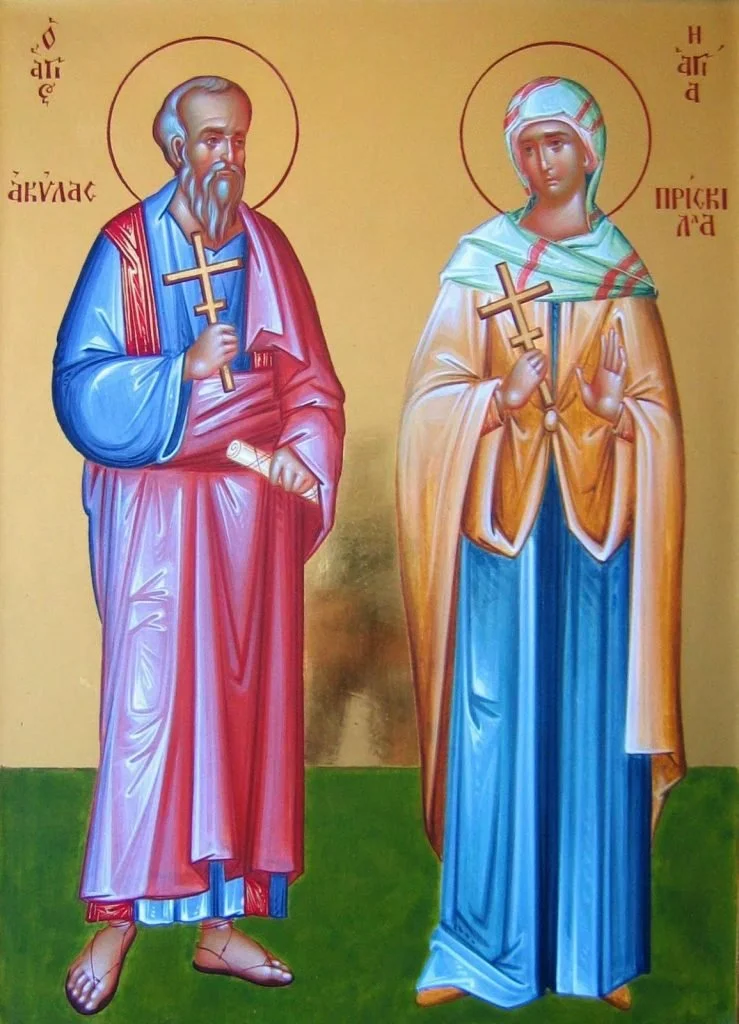
Acts 18:1-27, abridged from The Voice
From Athens, Paul traveled to Corinth alone. He found a Jewish man there named Aquila, [who with] his wife Priscilla had recently come to Corinth from Italy because Claudius had banished all Jews from Rome. Paul visited them in their home and discovered they shared the same trade of tent making. He then became their long-term guest and joined them in their tentmaking business.
Each Sabbath Paul would engage both Jews and Greeks in debate in the synagogue in an attempt to persuade them of his message…Eventually, though, some of the Jewish people stopped listening and began insulting him. He shook the dust off his garments in protest.
Paul said, “I’ve done all I can for you. You are responsible for your own destiny before God. From now on, I will bring the good news to the outsiders!” He walked out of the synagogue and went next door to the home of an outsider who worshiped God.
At the end of 18 months, Paul said goodbye to the believers in Corinth. He wanted to travel to the east and south to Syria by ship; so, accompanied by Priscilla and Aquila, …the three of them sailed east to Ephesus where Paul would leave Priscilla and Aquila. Paul [continued traveling]…visiting city after city…strengthening the disciples in each place.
Meanwhile, back in Ephesus, a Jew named Apollos made contact with the community of believers. He had been raised in Alexandria. Apollos was eloquent and well educated in the Hebrew Scriptures. He was partially instructed in the way of the Lord, and he added to his native eloquence a burning enthusiasm to teach about Jesus.
He taught accurately what he knew; but he had only understood part of the good news, specifically the baptism preached by John, the forerunner of Jesus. So, when Priscilla and Aquila heard him speak boldly in the synagogue, they discerned both his gift and his lack of full understanding. They took him aside and in private explained the way of God to him more accurately and fully.
Apollos [traveled] west, into an area where Paul had recently been, to preach there…Upon his arrival, he was of great help to all…who had, by the grace of God, become believers.
Sermon Transcript
We continue in our series about women leaders in the Gospels and in the early church. So far we have explored the contributions of Mary Magdalene, Joanna, Susanna, who were disciples of Jesus and financial supporters of his ministry, and Lydia, whose enthusiastic embrace of the gospel prompted the establishment of a church in her house in Philippi.
This week, we turn our attention to a woman named Prisca, who also went by the nickname Priscilla. When she is mentioned in Acts and in the letters of Paul, she is always mentioned alongside her husband, Aquila.
The two of them are mentioned a total of six times, and four of those times, Priscilla is mentioned first, ahead of Aquila.
I mean, it is a big deal that she is named at all, considering alllll the women in the Bible who get the “daughter of so-and-so” or “so-and-so’s wife” treatment.
For comparison, consider Peter’s wife: he is a contemporary of Paul, who also was a leader in the early church, who also went on missionary journeys to found and encourage new churches. Peter has a wife—who even traveled with him—and we never ever get to know her name. Which leads us to think maybe she didn’t take an active role in the work Peter was doing in the world, preferring to stay in the background.
Yet we get to know Aquila *and* Prisca, so clearly she took an active role in their ministry. We never hear about one without the other. *And* four out of six times, Prisca is mentioned first. Why would that be?
No reason is given. Perhaps she had a stronger force of will, or maybe it was her superior intellect that brought her name to mind ahead of her husband’s. Maybe she was born to a higher social class? We just don’t know.
But as I’ve said time and again, the biblical authors chose their words carefully. Who gets mentioned and how, matters.
So what was special about Prisca?
Well, even though we read her name six times in the Bible, the mentions in Paul’s letters are brief—one or two verses of greeting within a passage where he greets lots of people whom he has worked with in all the various places he has traveled. Those mentions are like this one from 1 Corinthians:
“The churches of Asia send greetings. Aquila and Prisca, together with the church in their house, greet you warmly in the Lord.”
Or in 2 Timothy: “Greet Prisca and Aquila and the household of Onesiphorus.”
So, not a lot to go on there. But in his greeting in his letter to the Romans, Paul does add some interesting detail:
“Greet Prisca and Aquila, my coworkers in Christ Jesus, who risked their necks for my life, to whom not only I give thanks but also all the churches of the gentiles.”
What’s this about risking their necks for Paul? Who knows, Paul was always getting into trouble, it could have been anything. But whatever it was, Prisca and Aquila put themselves at risk in protecting Paul.
Paul thanks them, and adds the thanks of “also all the churches of the gentiles.” Which gives us a hint that this pair was influential not just in one house church in one city, but that they were well-known throughout the region.
We get the most information in the book of Acts, chapter 18, which Joanne read parts of for us. Let’s take a closer look at that passage.
We catch up with Paul in his interminable travels as he heads to Corinth, in the south of Greece. There he meets the married Jewish couple: Aquila & Priscilla. They had just been evicted from their home in Rome, “because Claudius had banished all Jews from Rome.”
But why did the emperor Claudius banish all the Jews from Rome? At this time very early in the Christian church, it was all very confusing—was Christianity a subset of Judaism? After all, Jesus had been Jewish, and all of his early followers were also Jewish. So there was conflict between Jews who followed Jesus and those that did not.
There was also conflict *within* Christian churches on whether and how to admit non-Jews—in the translation I am using today, these folks are called “outsiders,” but most translations use the term “Gentiles,” which just means “not-Jewish.” Should the non-Jewish folks be required to follow Jewish ways of living and worship, or should a new way be found to be a new kind of believer who follows Christ, regardless of one’s ethnic background?
So, there was a lot of conflict to go around. And it is probable that the disturbances between Jews who followed Jesus and those who did not got to be too much for the Roman authorities, so the emperor Claudius kicked them all out to maintain order.
This ban on Jews lapsed with the death of Claudius about 5 years later, and Jewish folks (both those who did and did not follow Jesus) began returning to the city, which is how Paul was able to send greetings to Prisca & Aquila in Rome just a few years after the events of our story today.
All that to say, Prisca & Aquila had been forced to leave Rome and the home they had made there, and Paul met them where they had settled temporarily in Corinth. It’s unclear whether they were already followers of Christ or whether Paul won them over. What is clear is that they all *really* hit it off. Turns out they were all in the same trade—tent making. Paul moved in with them and they all went into business together, making tents.
But you know Paul, he wasn’t in Corinth just to stitch some canvas together. He was there to preach the way of Christ! So, every Sabbath he would go down to the local synagogue and debate anyone who would engage with him, whether they were Jewish or Greek.
As time went on, the Jewish people at the synagogue tired of Paul’s relentless debating. The text says that “some of them stopped listening and began insulting him.” So, “He shook the dust off his garments in protest” and left.
I love that. “He shook the dust off his garments in protest.” It was a little like shouting, “I know when I’m not wanted!” before slamming the door on the way out.
But there is a precedent here—Paul’s dusting himself off echoes Jesus’s instructions to the Twelve in Matthew, when Jesus sent them out on mission. He gave them instructions on where and how they were to travel, and he ended with this: “If anyone will not welcome you or listen to your words, shake off the dust from your feet as you leave that house or town.”
Now, I don’t know who needs to hear this today, but let me tell you: it is ok to disengage from folks who refuse to engage in good faith with you. It is ok to step back and step away from situations and from people who do not welcome you, who insult you, who do not listen to you. It is ok to shake the dust from your clothes and just walk away. You do not need to spend any more of your time and energy on folks who return your good will with insults.
And so Paul had had enough of the folks in the synagogue and their refusal to listen and their insults. He said, “I’ve done all I can for you. You are responsible for your own destiny before God. From now on, I will bring the good news to the outsiders!” He walked out of the synagogue and went next door to the home of an outsider who worshiped God.” And where presumably he was given a warmer welcome.
This arrangement in Corinth—living with Priscilla and Aquila, working together to make tents during the week, and seeking out converts to the way of Christ on the weekends—it all lasted a year and a half.
Then Paul was ready to move on, and this time, Priscilla and Aquila traveled with him. The three of them traveled by boat from Corinth (which, again, is in the southern part of Greece) to Ephesus (which is in the eastern part of Turkey).
After staying just a short while with them, preaching in the synagogue there, Paul left the couple in Ephesus, while he continued on, “visiting city after city…strengthening the disciples in each place.”
Which would have been, like, his favorite thing to do.
While Paul was traipsing across the Middle East, Aquila and Priscilla were getting settled into Ephesus and founding the church there.
At some point, the community of believers in Ephesus was approached by a Jewish man named Apollos. Apollos was from Alexandria, a city that was world famous for its library and was widely regarded as a seat of higher learning. Apollos had clearly taken advantage of his city’s opportunities for scholarship, since he is described as “eloquent and well educated in the Hebrew Scriptures.”’
And he also was enthusiastic! He was ready to speak out with eloquence and elegance about Jesus!
But there was a problem: he had only learned part of the story. He lacked a full understanding of the way of Jesus. What he knew he spoke boldly and convincingly, but he only knew so much.
Priscilla and Aquila listened to Apollos speak in the synagogue, and they immediately read the room and thought, “Here is a guy who is smart, well-spoken, and eager. All he needs is a little tutoring.”
So, the text says “they took him aside and in private explained the way of God to him more accurately and fully.”
Let me underscore—it was *they* who pulled him aside and explained to him. And this is one of those instances where Priscilla’s name gets listed before Aquila’s. Perhaps because she was the one who was more active in doing the explaining?
This is an instance of a woman (alongside her partner) giving instruction to a man. This is significant, because 1) it would have been unusual at the time, and 2) in many churches today, it would still be unusual. But here, it happens, and no one seems troubled by the occurrence of a woman instructing a man in matters of theology.
In fact, Apollos seems to have taken it all rather well! After his private tutoring at the hands of Priscilla and Aquila, Apollos is ready to branch out on his own, following in the footsteps of Paul to another church where he could preach the gospel of Christ. The text says:
“Upon [Apollos’s] arrival, he was of great help to all in [that region] who had, by the grace of God, become believers. This gifted speaker publicly demonstrated, based on the Hebrew Scriptures, that the promised Anointed One is Jesus. Then, when the Jewish people there raised counterarguments, he refuted them with great power.”
Apollos went on to become as influential a leader in the early church as Paul. Paul mentions him several times in his letters as a fellow missionary who moved from church to church, city to city, preaching and inspiring believers.
But what if Priscilla and Aquila hadn’t pulled him aside that day? What if they hadn’t decided to help him learn? What if he had refused to listen? Things could have been really different if Prisca and Aquila had not stepped in and spoken up.
Sometimes we think we aren’t smart enough, or we won’t be able to find the right words, or we feel too self-conscious to speak up to another person about matters of faith, to share the effect that God has had on our own lives.
Priscilla and Aquila could easily have thought they weren’t right for the job of tutoring Apollos. After all, they were tentmakers, and Apollos was a scholar from one of the most famous universities around!
But speaking about our own experience of faith doesn’t take a college degree or specialized training. What it takes is courage and a willingness to step out of our comfort zones to tell someone how our faith has impacted our lives and our values and how our faith influences the decisions we make and the things we put our energy and time into. I mean, why would we keep something so significant to our lives a secret?
Now, I am not suggesting that you go knock on doors or stand on street corners passing out religious pamphlets. What I am saying is—be ready to share what matters to you with people who matter to you, when the opportunity arises.
I think that Stef helped some of you to make a good start of it when she asked the question, “Why do you choose to come to Homer Congregational Church?” She recorded those answers and made a video, a part of which she shared on our social media this past week, and there is more on our YouTube channel. It is absolutely worth a watch.
May it inspire you to reflect on why this church and your faith matters to you. And may we all have the boldness of Prisca and Aquila in speaking up when it matters, when we have important matters of faith to share, when it is the right thing to do.
But also remember: if you find yourself in spaces where your authentic self is met with hostility and insult, where your attempts at earnest dialogue are shut down, you can and should shake the dust off your clothes, walk out that door and into one that is open to you.
So let us go from here to wherever you go this week, with the courage of our convictions and a readiness to share with our neighbors and friends why your faith matters to you.
Amen!