Women Should Be Silent

This is sermon #6 of 6 in my series on women leaders in the Gospels & the early church. For this final sermon in the series, I wanted to tackle the scriptures most often used to keep women in subordinate positions within church leadership. Thanks for following along! This has been a really fun sermon series to research and write, and it was well received by the congregation.

--Rev. Stephanie Spitzer-Hanks, 2nd Sunday after Pentecost 2026, Homer Congregational Church, United Church of Christ, Homer, New York


For those of you who prefer to listen instead of read the sermon, I usually cue the video to begin at the beginning of the sermon. But this week, I cued it to the beginning of the scripture reading by one of the deacons. Listen for the spontaneous laughter from the congregation! The sermon follows immediately after the scripture is read.

Also: technical difficulties persist, so this week’s worship service does not include video, but the audio is great!


1 Corinthians 14:34-35

Women should be silent in the churches. For they are not permitted to speak but should be subordinate, as the law also says. If there is something they want to learn, let them ask their husbands at home. For it is shameful for a woman to speak in church.

1 Timothy 2:11-12

Let a woman learn in silence with full submission. I do not permit a woman to teach or to have authority over a man; she is to keep silent.


Sermon Transcript

How did it feel, hearing those two passages that Sam just read?

“Women should be silent in the churches. For they are not permitted to speak but should be subordinate, as the law also says. If there is something they want to learn, let them ask their husbands at home. For it is shameful for a woman to speak in church.”

And “Let a woman learn in silence with full submission. I do not permit a woman to teach or to have authority over a man; she is to keep silent.”

Those passages take me back to my childhood and adolescence, and they feel like a punch to the gut. I grew up in a Southern Baptist Church in a small town in East Texas, where passages like these were taken as a rule that we must follow. We had no women who were deacons, and we certainly had no women who were pastors. The only time a woman could stand up and take the microphone in church on Sunday morning was if she were singing a solo.

Otherwise, you could find plenty of women in the pews, in the kitchen preparing food, leading women’s groups, teaching in children’s Sunday school classrooms—but never in adult ones. If there were adult men learning, then it must be men who were teaching.

It is different now, somewhat, in the church where I grew up. Some of the rules have been relaxed a little. But it is still a far cry from, say, this church—here at Homer Congregational Church, all of our deacons are women, your previous pastor was a woman, as is your current preacher. Who will be next? Well, we still don’t know, but I believe there would be no objection to another woman as pastor.

So, who has it right? The church I grew up in, which is like many, many congregations all over the country and the world, or this church, and others like it? Should women be silent? After all, that is what the text says, we all heard it. It’s there in black and white.

The other churches would say that we are ignoring the scriptural mandate. It’s clear!, they would say. Women are not to teach or have authority over a man in church. Period.

But is it that *we* are ignoring what the Bible says, or is it those other churches who are ignoring the Bible?

I have spent the past five weeks that I have been in the pulpit on a series of sermons about women leaders in the Gospels and in the early church. We learned about Mary Magdalene, Joanna, and Susanna, who were disciples of Jesus and financial supporters of his ministry. And Mary Magdalene was the apostle to the apostles—chosen and sent by the risen Jesus to bear the message back to the other disciples that he had overcome death.

And in the book of Acts and in Paul’s letters to the churches spread throughout the Roman Empire, we met several women who were co-workers with Paul and house church leaders in the earliest days of the church: Lydia, Priscilla, Chloe, Mary the mother of John Mark, Apphia, Nympha, Euodia, and Syntyche, among others.

We learned that Priscilla, along with her husband Aquila, instructed another minister (note: a *male* minister!) named Apollos. He only knew part of the message of Christ, so Priscilla and Aquila taught him the rest.

We met Phoebe, a deacon or minister in her church, who was a church leader in her city, sharing her wealth with them and with Paul as well.

We rediscovered Junia, whose name was obscured in the biblical text for centuries because biblical scholars simply could not believe that Paul would refer to a woman as “prominent among the apostles.”

One thing I can say for the Baptist tradition that raised me, they did teach me to read the Bible. But, I don’t know, maybe they taught me a little too well? Because I when I read my Bible I find plenty to contradict these two pairs of verses.

So, after hearing about all that these women did,—I’ll ask again: who is it that is ignoring the biblical text? Is it me, who sourced these women’s stories from multiple verses, in multiple chapters, in eight different books in the New Testament? Or is it the folks who want to choose 2 pairs of verses from 2 books, and make those prescriptive for every church, everywhere?

What are we to do, then, with these passages? Do we just ignore them, and assume, based on the weight of evidence found elsewhere in the New Testament, that these statements are one-offs, written for a specific problem in a specific church (or two) during the early days of the church? And that they are not meant to apply to every church, everywhere?

Yes. Yes, we could do that. It is a legitimate approach to interpreting the scriptures. When confronted with a confounding passage, it is always a good idea to stack it up against what we hear God saying across the whole of scripture, and ask: does this seem to fit? Or is this an outlier that we can pay less attention to?

We can also ask: Is there some cultural or historical context I’m missing here that would make this make more sense? Sometimes the answer is to be found in the surrounding verses. It is always a good idea to go ahead and read the whole section or chapter, instead of just one or two verses taken out of context.

Sometimes the context we need is found in the cultural or historical setting of the book where the scripture is found. In a study Bible, this information can often be found in the introduction to the book.

And sometimes you need your nerdy preacher to go digging around to see what various biblical scholars have to say about a passage in order to make any sense of it. That’s what I’m here for!

Let’s look first at the passage from 1 Corinthians:

Paul writes that “Women are to keep silent in churches.” I mean—like, how is that even going to work? Of course we are going to speak in church. Even if we are not speaking from the pulpit, I bet all of the women in here have said *something* since they arrrived this morning.

And this prohibition on speech makes even less sense if you flip back just three chapters in this same letter to the church in Corinth, where Paul gives very particular instructions about how women should present themselves *when they are praying and prophesying in church.* So, why would he give directions about *how* women should pray or prophesy in church, if he meant for us to understand here that women should not be praying or prophesying at all, but should instead be completely silent.

So what could he mean? Well, one of Paul’s reasons for writing to this church in Corinth was that they were getting a reputation as a rowdy bunch. Folks were talking over one another during worship, having noisy side conversations, and generally making it impossible for anyone to be able to hear what was being said. As you can imagine, it was a big problem!

In this letter Paul tells multiple groups of people to keep it down during their time of worship—it’s not just women who need to be quiet so others can hear: he also tells people who are speaking in tongues and people who are prophesying to be quieter and more orderly about it.

It’s also possible that the women in Corinth just were not used to having this much freedom and they let it go to their heads a little bit. Have you ever known (or maybe you yourself have been?) a teenager whose parents were a little overprotective and controlling, so when that teenager finally moved out they took their newfound freedom a little too far? They went a little wild, because now they could?

Well, maybe it was like that for the women in Corinth. They weren’t used to being able to speak up and express themselves in a public place, so maybe when they got their chance, they didn’t quite know how to handle themselves? It’s possible.

This theory also might help explain the part about how “if there is something [the women] want to learn, let them ask their husbands at home.” Women had far less education than men in that time and place, so maybe Paul is saying,“Hey, instead of shouting out your questions, or having loud side conversations during worship, maybe you could save your questions and ask them of your husband (who almost certainly has a higher level of education, and could probably explain things in a calm and quiet manner) at home?”

Then the message is not “don’t ever use your voice to participate in worship.” But it’s “just do it in an orderly manner that allows everyone to hear.”

Ok, then what about the other passage? It is very similar to the admonition to be silent during worship that Paul gave to the Corinthians, but then there is this additional sentence: “I do not permit a woman to teach or to have authority over a man.”

Let’s recall Priscilla, who, along with her husband Aquila, pulled Apollos aside to teach him matters of theology. And Junia, who was “prominent among the apostles.” And all of those house church leaders, who, you know, *led* churches that had both women and men in them. We know that women were leaders in the church! So what could this mean: “I do not permit a woman to teach or to have authority over a man.”?

Well, this letter is written to Timothy, who was working with the church at Ephesus. And one thing that is important to know about Ephesus at that time—it had a large temple to the goddess Artemis, and the worship of Artemis was run entirely by women. Women were in charge of everything, and they told the men what they could and could not do.

So, it’s possible that the concern here is to not allow the female-dominated worship of Artemis to influence the style of worship within the Christian church. This is further supported by the fact that the Greek word that is here translated as “have authority” actually means more like “to domineer” or “have abusive authority over.”

So, maybe it’s not that women are not to “have authority” over men, but that they are not to be *abusive* or controlling of their fellow men in Christian worship, like was happening in the worship of Artemis on the other end of town.

Maybe—the idea is that neither men nor women should abuse the power that they have found in Christ. Maybe one gender should not be placed as the authority, and one gender be subordinate. Maybe, it’s that all of us are given gifts that are equally valued among the congregation, and those gifts are given by God indiscriminately both to women and to men.

———

So, when we unpack the context of these two pairs of verses, we start to see that maybe they don’t mean what they seem to mean when they are pulled entirely out of their context.

The truth is that anyone can pluck a verse or two out of context from the Bible to support any position they want. People have used careully selected Bible verses to justify: enslaving other humans, genocide, racial segregation, domestic partner abuse, child abuse, authoritarianism, and violence against LGBTQ+ folks, among other atrocities.

It’s relatively easy to justify whatever bigotry or prejudice or hatefulness you want by plucking a verse or two from the Bible, divorcing it from it’s context, and shoving it down people’s throats. It’s easy, but of course, it isn’t right.

I wish I didn’t have to say this, but the Bible is not a weapon to be wielded against our perceived enemies, and it is not a crutch to support our tightly held prejudices.

What the Bible is: a God-inspired source of comfort and consolation, a record of how people across many lands and ages have understood who God is and how God works in the world, a revelation of who Jesus is and how we can know God through his words and his person.

If we think of the Holy Spirit as the spark, then the Bible is the tinder that lights the flame of our holy imaginations, as we envision what the world could be, and how we could work together to bring the kingdom of God on earth as it is in heaven. The Bible is all these things and more!

———

I made the plan to do this whole series on women leaders in the New Testament a couple of months ago, finishing today with these two passages that have been used to keep women in a subordinate position in the church.

But coincidentally, this very week the Southern Baptist Convention is having their annual meeting. And they will be voting on a resolution to require all Southern Baptist Churches to prohibit women from the role of pastor, specifically in preaching to the congregation.

I don’t think it will pass (similar resolutions have failed twice already in previous years), but we will see. But the truth is that the idea that women should be silent in church is still alive and well.

What I hope is that all the little girls—and the little boys, too, because they need to hear it just as much as the girls do—I hope and pray that all the children sitting in those churches hear another perspective on this issue some day, and I hope they experience the expansive view that is out there that each of us, regardless of our biological makeup or our gender expression, is gifted by God, and each of us is cherished as co-workers in the gospel of Christ.

Because we are not in the business of exclusion and of keeping anyone “in their place.” Let’s never forget that in here, in this messy and sometimes broken place that is the Church, we are in the business of doing what Christ did: which is seeing and valuing and loving people for who they are—no matter what they look like, or where they fit in society.

And that is good news indeed.

Thanks be to God!

Want to get an email when I publish a new post?

* indicates required

Intuit Mailchimp

I promise I will not share your information with anyone. Filling out this form means you will get an automated email from Mailchimp the day after I post anything to this blog. You can unsubscribe anytime! It won’t hurt my feelings. :)

Phoebe & Junia: Lost in Translation

This is sermon #5 of 6 in my series on women leaders in the Gospels & the early church. This sermon is about two women who were lost in translation—whose roles in the early church were nearly erased due to bias in translation and transcription in the biblical text.

--Rev. Stephanie Spitzer-Hanks, 1st Sunday after Pentecost 2026, Homer Congregational Church, United Church of Christ, Homer, New York

Junia, Serigraph, Remembering the Women: Works by Luba Lukova. Art © Luba Lukova


Unfortunately, there were technical difficulties so a recording of this worship service is unavailable.


Romans 16:1-7 (NRSVUE)

I commend to you our sister Phoebe, a deacon of the church at Cenchreae, so that you may welcome her in the Lord, as is fitting for the saints, and help her in whatever she may require from you, for she has been a benefactor of many and of myself as well.

Greet Prisca and Aquila, my coworkers in Christ Jesus, who risked their necks for my life, to whom not only I give thanks but also all the churches of the gentiles. Greet also the church in their house. Greet my beloved Epaenetus, who was the first convert in Asia for Christ. Greet Mary, who has worked very hard for you. Greet Andronicus and Junia, my fellow Israelites who were in prison with me; they are prominent among the apostles, and they were in Christ before I was.


Sermon Transcript

This morning I am back in the pulpit, so we are back to our series about women leaders in the Gospels and in the early church. So far we have explored the contributions of Mary Magdalene, Joanna, and Susanna, who were disciples of Jesus and financial supporters of his ministry.

And in the early church so far we have learned about several women who were co-workers with Paul and/or house church leaders in the earliest days of the church: Lydia, Priscilla, Chloe, Mary the mother of John Mark, Apphia, Nympha, Euodia, and Syntyche, among others.

This week we will add two more names to the list—and these two are notable because over the centuries that the Bible has existed, they, or at least their roles, have been lost in translation.

But before we get to their stories, I need to make sure we all understand about how the Bible we have now came to be, because understanding that is essential to understanding these women’s stories, and how it could be that for hundreds of years, they were essentially erased from our Bible.

What we now know of as The Bible—a bound book in two parts, each of which is comprised of many different books, each with their own author, or sometimes multiple authors within the same book—it was written mostly in Hebrew and Greek, with a bit of Aramaic sprinkled in.

So the Bible has many, many voices and perspectives, recorded over many, many centuries into the one volume we have today. But who decided which books got to be in the Bible and what order they should go in?

For the Hebrew Bible, it was Jewish rabbis and scholars who decided what would be included in the Law, the Prophets, and the Writings. They had figured this out pretty authoritatively a couple hundred years before Jesus was born.

And then for the New Testament, there was a whole process about 300 years after Jesus with a bunch of councils and debates and committee meetings. And then finally they came to a consensus of which books to include in the New Testament.

Once it was decided which books would be included the Bible, then there were lots of people whose job it was to make copies of the scriptures, and to translate the scriptures into other languages. They didn’t have printing presses, and they certainly didn’t have Google Translate, so it was up to human hands and minds to physically copy the words onto paper, and to decide which words to use in another language when translating the scriptures.

And since they were human, mistakes were made. Sometimes copying errors happened, where lines were omitted, or words were transposed. And sometimes translation errors were made, where maybe the word chosen in another language changed the meaning of the text away from what it had originally meant. Sometimes it is impossible to find an exact word for word translation when going from one language to another, and we are forced to paraphrase. And sometimes people choose the wrong word because of their own biases.

And then—over time, old copies of manuscripts got lost or destroyed or just turned to dust and became unreadable. So all we are left with are newer copies (that might have mistakes in them) and translations of the original (which may have translation errors in them).

Have you ever been reading your Bible and noticed a little footnote at the bottom of a page that said something like, “some manuscripts add [some extra words]” or “other ancient authorities read [something different].” Well, this is why—because we don’t have the original versions of any part of the Bible. We have copies and we have translations and copies of translations—and, because humans copied and translated these versions, none of them match one another exactly.

You can see this even when looking at modern versions of the Bible in English—read a passage in the King James Version and it is pretty different from the version we usually read from in worship (which is the New Revised Standard Version, in case you were wondering). So even modern translations in English can end up with entirely different words on their pages, for all sorts of reasons.

Ok, so now that I’ve gone on that massive tangent, let’s get back to the women who I want to talk about this morning, and hopefully that whole explanation I just gave will be helpful.

In the passage read for us today from Paul’s letter to Romans, in the first 2 verses of chapter 16 Paul tells the Roman church to welcome Phoebe, who has traveled from a far away church. He writes:

“I commend to you our sister Phoebe, a deacon of the church at Cenchreae (SEN-cree-ā), so that you may welcome her in the Lord, as is fitting for the saints…”

The word “deacon” is here is from the Greek word “diakonos”—so it is really less of a translation and more of a transliteration, that is, it doesn’t so much define the word as it just changes the letters around a little bit to make it sound like an English word. So “diakonos” gets changed to “deacon.”

But what does the word “deacon” actually mean? Well, we have deacons in our church, right? What do they do? They help, they serve, they lead, they organize. They do a lot of things, and we are so grateful to them for all the work they do on the church’s behalf! You could sum up what they do as ministering to the church, and in the New Testament, translators often use the word “minister” when they want to translate the Greek word “diakonos.”

Elsewhere in the Greek New Testament, Paul refers to himself as a “diakonos”, which often gets translated as “minister.” Same goes for the place where Paul calls his co-worker Timothy a “diakonos”—most translations say Timothy is a “minister.”

But guess what? When Paul calls Phoebe a “diakonos,” many translators who used the word “minister” for Paul or Timothy, now choose the word “servant” for Phoebe.

Why choose a different word? Well, Paul and Timothy are men, and Phoebe is a woman, so some translators let their own bias about who is and who is not qualified to be a deacon or minister creep in. So, in many translations over the centuries, Phoebe is allowed to be a “servant” of the church, but not a “minister,” simply because she is a woman and not a man.

And the translation bias against Phoebe doesn’t stop there! In the next verse, after Paul says the church in Rome should welcome Phoebe, he writes that they should:

“help her in whatever she may require from you, for she has been a benefactor of many and of myself as well.”

Now we are going to focus on the word translated here as “benefactor.” Our version uses “benefactor,” but other translators chose “patroness” (not patron, but patroness, because we need reminding that she is a *woman*), and still other translators chose the word “helper.”

Ok. But here’s the thing: in other places in the New Testament where a form of this word gets used to refer to men, it gets translated as “leader” or “ruler” or “manager.”

So for a woman, we get “benefactor” or “helper,” but for men we get “leader” or “ruler.” Hmm.

It is clear that Phoebe was a wealthy woman who used her wealth to support her church and to support Paul. Under the Roman system of patronage, using one’s wealth to support others would confer a certain amount of power. But here it seems that, while Phoebe gets credit for sharing her wealth as a benefactor, she does not get acknowledged as the leader she likely was in the church.

And if the way Phoebe gets treated by translators isn’t bad enough, wait until you hear about Junia! A bit further down in this 16th chapter of Romans, Paul send greetings to:

“Andronicus (An-DRAH-nǐ-cus) and Junia, my fellow Israelites who were in prison with me; they are prominent among the apostles, and they were in Christ before I was.”

In just about every English language Bible, there is a little note after Junia’s name that says something like:

“Or Junias; other ancient authorities read Julia.”

So which is it? Junia, or Junias, or Julia? How can there be so many options?!?

Well, if Phoebe fell victim to translator bias and error in erasing her position in the church, Junia is a victim of transcription. Remember how I said that it was someone’s job just to copy out the text of the scriptures by hand?

Well, somewhere after those first few centuries, some scribe or scholar somewhere was reading as he was copying, and he saw that Junia had been imprisoned with Paul, and that Paul described this person as “prominent among the apostles,” and the scribe thought, “Nahhhh, this must be a mistake! Paul couldn’t possibly have meant a *woman* was an apostle! It must be that the “S” got left off somewhere. Here, I’ll fix it.” And so, for centuries, Junia became Junias.

But all of the oldest manuscripts we have say either Julia or Junia (which were both common names for Roman women), not Junias (which was the name of no Roman man at the time).

So there was no mistake. It was Junia (or possibly Julia, but let’s stick with Junia just to be slightly less confusing) whom Paul praises so highly, calling her and her colleague (probably her husband or a close relative) “prominent among the apostles.”

Fortunately, most modern Biblical scholars and translators are in the habit of going back to the oldest manuscripts that we have available, and since those manuscripts clearly use a woman’s name, Junia has been restored to the pages of our Bibles at last.

However, there are some today who still try to erase Junia by saying that we should translate this verse as saying that she and Andronicus were well known TO the apostles, but not actually AMONG the apostles. Because there are definitely still folks today who cannot abide the notion that yes, the role of apostle was open to women as well as men. They also have to conveniently forget that Jesus himself sent Mary Magdalene as an apostle to the apostles on that very first Easter morning. But they have no problem with dismissing that, either.

———

I also want to say this morning that it is not just women who have been the victims of bias from translators of the Bible. The year before we moved from Waco, my family had a chance to attend a screening of the documentary 1946: The Mistranslation That Shifted Culture, which is all about how the word “homosexual” appeared in a translation of the Bible for the very first time in 1946. The film asserts that this was a mistranslation and caused irreparable harm to the LGBTQ+ community. I recommend the film, it is available to watch online.

The problem here is that the Greek words that they chose to translate as “homosexual” in 1946, are really weird Greek words, and no one reallly knows what they mean. We think they have *something* to do with men having sex with men (or possibly boys?), but there is a really good chance that the sex was abusive and/or exploitative in some way. It certainly didn’t refer to sex between consenting adults of the same gender, since that whole concept (at least in a legal sense) didn’t really exist until about 50 years ago. Choosing a word that could refer to a loving, consenting relationship to include in a list of actions that are clearly sinful has certainly caused harm to LGBTQ+ folks.

———

So, the words translators choose matter. The words translators use are powerful, especially when we are talking about the Bible, which we use to help shape our understanding of how the world should be, and how we should relate to one another and to God. When translators and scholars make mistakes—it matters.

Are there ways that people with power over these words have tried to shape the message to their own ends, tried to bury the truth that the love of God expressed in Jesus is one of inclusion? Yes.

But—there are also people who don’t give up on that idea. Who continue to wrestle with the biblical text, instead of abandoning it altogether. Who make discoveries and who petition for corrections to be made. And there is hope in that. There is hope that Christ’s message of inclusive love cannot be always obscured.

Because what made Jesus so extraordinary, was that he could cut through all the noise and all the cultural barriers that society erects between us, and he touched people. He connected with them. He saw the inherent value in people, no matter what the prevailing attitude of society was toward them.

And we know about that because we read it in our Bible. But how can something so messy truly help us to see and know God? The Bible is God-inspired, but it has human fingerprints all over it. And not clean fingerprints—messy, sticky ones, like a toddler who has been eating chocolate and got hold of a favorite book.

And yet. In spite of (or maybe because of? I can’t tell which.) the mess we have made of this holy book, we can still find God when we look. Because thank the Lord, God is still speaking, and not just through the words we find in these pages, but also through the Spirit-filled connections we make with one another and with this amazing world God made. And there is definitely hope in that.

Thanks be to God!

Want to get an email when I publish a new post?

* indicates required

Intuit Mailchimp

I promise I will not share your information with anyone. Filling out this form means you will get an automated email from Mailchimp the day after I post anything to this blog. You can unsubscribe anytime! It won’t hurt my feelings. :)

The Church in Her House

This is sermon #4 of 6 in my series on women leaders in the Gospels & the early church. Here we will learn about the additional women who were leaders of house churches, plus the wider question of how the early church figured out how to be the Church.

--Rev. Stephanie Spitzer-Hanks, 7th Sunday in Easter, 2026, Homer Congregational Church, United Church of Christ, Homer, New York

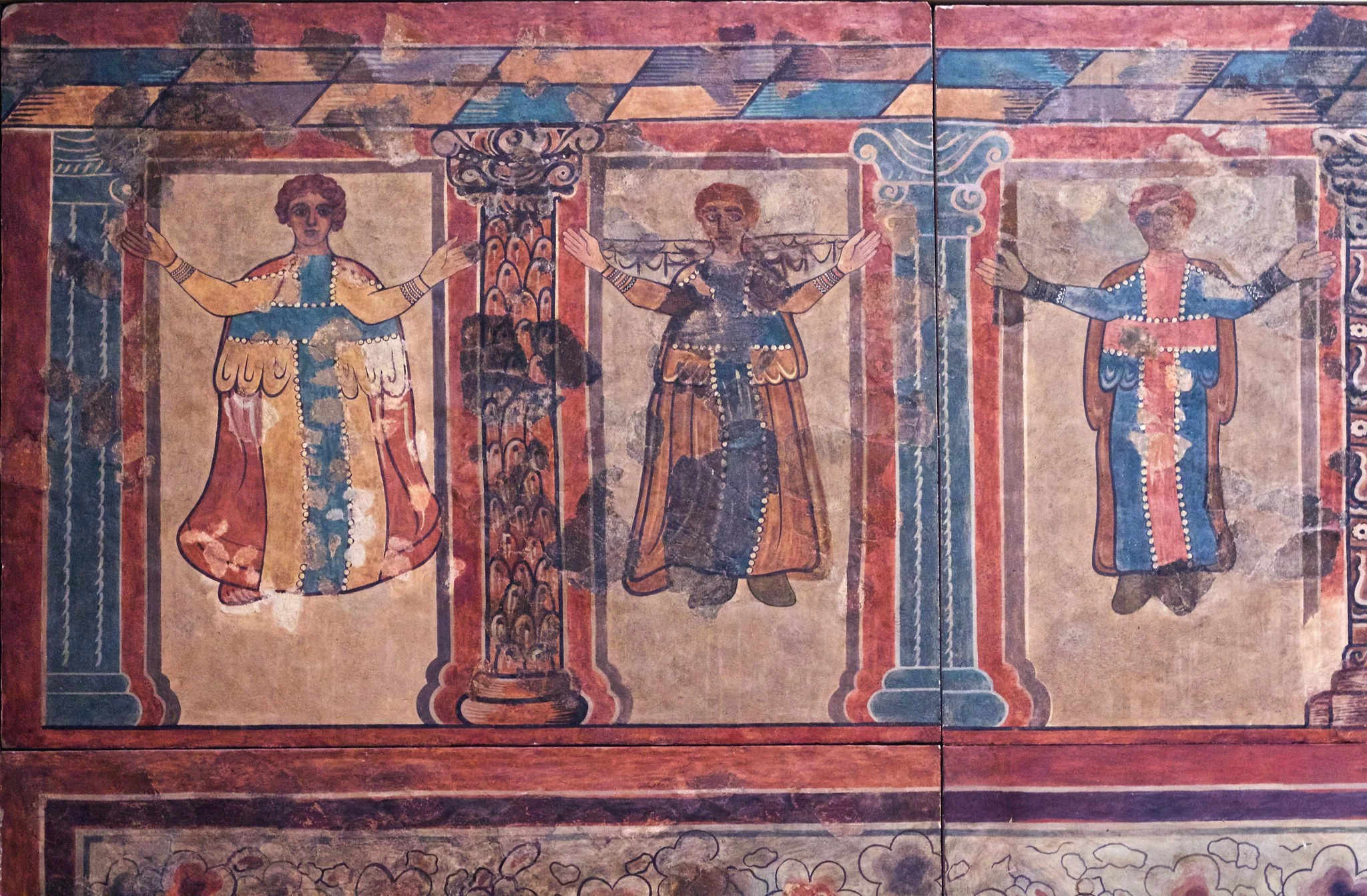
Painted walls from Lullingstone Roman Villa, 4th cent. AD, Lullingstone, Kent. Photo by Nick Thompson. https://flic.kr/p/DT5xoM


If you prefer to watch instead of read the sermon, the video should begin at the beginning of the sermon.


1 Corinthians 1:10-13 (NRSVUE)

Now I appeal to you, sisters and brothers, by the name of our Lord Jesus Christ, that all of you be in agreement and that there be no divisions among you but that you be knit together in the same mind and the same purpose. For it has been made clear to me by Chloe’s people that there are quarrels among you, my brothers and sisters. What I mean is that each of you says, “I belong to Paul,” or “I belong to Apollos,” or “I belong to Cephas,” or “I belong to Christ.” Has Christ been divided? Was Paul crucified for you? Or were you baptized in the name of Paul?


Sermon Transcript

We continue in our series about women leaders in the Gospels and in the early church. So far we have explored the contributions of Mary Magdalene, Joanna, and Susanna, who were disciples of Jesus and financial supporters of his ministry.

And in the early church so far we have learned about Lydia, whose enthusiastic embrace of the gospel prompted the establishment of a church in her house in Philippi, and then Prisca & her husband Aquila, who were co-workers in the gospel with Paul in multiple cities.

Our list of names grows by the week! And today I am going to add six more names to the list of women who were leaders in the early church, who opened their own homes as leaders of house churches.

We’ve been on this journey of learning about the early church—how it was founded, how it spread, and we’ve found that almost every story about the early church includes Paul. It is estimated that he traveled more than 10,000 miles on his missionary journeys—some of it in a boat, but a lot of it on foot. The man was tireless.

As I’ve said before, Paul had a habit of traveling to a new place, finding a place to preach the gospel of Christ, attracting converts to this new Way of Jesus, establishing churches in the homes of these new converts, and often getting arrested before he moved on to a new town to do it all over again.

And along the way, he would make time to write letters back to those churches that he had founded. Many of those letters were copied and passed around and saved and collected to form a good chunk of our Bible. But why did he write all of these letters to all of these churches? Mainly because he thought they were going about things in the wrong way.

I mean, he also wanted to encourage these new believers, and guide them, and give them more matters of faith to chew on so that they could mature as believers. Those are things he did in his letters. But often, he would get wind of conflicts and factions within house churches or between churches in the same city, and he would write to clear things up and get the churches back on track.

You have to understand, they were really making up this new religion as they went. I mean, of course, they were inspired by God and the teachings of Jesus, but logistically how that all was supposed to work in practice as a new way of relating to God and one another as communities of faith? They were figuring it out as they went.

And it was not just Paul who was traveling and preaching and guiding new churches—there were other people doing this work, too. Like Peter (who, confusingly, also went by Simon and by Cephas), and Apollos (whom we met last week, when Priscilla and Aquila pulled him aside and instructed him more fully in the Way of Christ.) And certainly there were other itinerant preachers who made the rounds throughout the Roman Empire, bringing good words to the churches, but also maybe confusing them a bit. Because different preachers bring different perspectives, right? The same is true today.

And that was what was happening in the text Joanne read today, from Paul’s letter to the church in Corinth:

“Now I appeal to you, brothers and sisters, by the name of our Lord Jesus Christ, that all of you be in agreement and that there be no divisions among you but that you be knit together in the same mind and the same purpose. For it has been made clear to me by Chloe’s people that there are quarrels among you, my brothers and sisters. What I mean is that each of you says, “I belong to Paul,” or “I belong to Apollos,” or “I belong to Cephas,” or “I belong to Christ.” Has Christ been divided? Was Paul crucified for you? Or were you baptized in the name of Paul?”

It seems that in Corinth, “Chloe’s people,” that is, the church that Chloe led in her house, have been snitching to Paul, that the churches in Corinth have split into factions. Some of the new believers there claim to “belong to” Paul, others to Apollos, others to Cephas, and still others say, “I belong to Christ.”

Paul comes down firmly in the “I belong to Christ” camp. One thing you can say about Paul: he was not interested in creating a cult of personality around himself. He always acknowledged Christ and the cross as central. He rather saltily asks, “Was Paul crucified for you? Or were you baptized in the name of Paul?” Of course, the answer is no. It was not Paul, but Christ who was crucified, and they were all baptized in the name of Jesus. Really, you would think they would remember that.

But, then as now, it is easy to fall into the trap of placing one’s allegiance in a leader or a movement that has captured our attention in this present moment, rather than in Jesus, whose presence endures, to be sure, but who might be less immediate to us, less tangible. Easier to ignore.

So the churches in Corinth were arguing, but this sort of thing was not unique to Corinth. All of the churches were arguing amongst themselves about something.

But what sort of things did they argue about? A reallllly big one was the question of how to integrate Gentiles (or non-Jews) into this new religion, all of whose adherents in the beginning were Jewish. There were quite a few Gentiles who were interested in Jesus, and Paul and Peter and Apollos had all preached inclusion of non-Jews.

But the question kept coming up: Did non-Jews who wanted to follow Jesus need to follow Jewish practices? Jesus had been a Jew, who had followed Jewish practice. It was a big question, and one that Paul spent a LOT of time answering.

In his letter to the Galatians he gets downright angry with them. In chapter 3 verse 1 he says, “You foolish Galatians! Who has bewitched you?” Remember, Paul had a tendency to get pretty cranky sometimes.

It turns out that after Paul left the church he helped the Galatians found, some different folks came and decided it would be a good idea to impose Jewish laws and customs on the Gentile members of the congregation, even going so far as to say that the male Gentile believers needed to be circumcised! You can imagine how well received that idea was.

Paul put the kibosh on that and told them that they couldn’t be more wrong. Paul had taught them a faith based on grace and love, not on rules and regulations. And he was ticked off that they had thrown away his teaching about the freedom that the love Christ has for each of us brings—a freedom to love one another as Christ loves us, a love that transcends the divisions that we like to make between one another.

Toward the end of the chapter that Paul began by calling the Galatians foolish, is one of the most quoted verses from all of his letters. He wrote:

“There is no longer Jew or Greek; there is no longer slave or free; there is no longer male and female, for all of you are one in Christ Jesus.”

This verse really stands out, because it is so radical. Paul said that “in Christ Jesus we are all children of God through faith.” When we make distinctions between Jew or Greek, or slave or free, or male or female, we lose sight of how God sees us—as all children of God, none of us better or more privileged in the eyes of God than the other.

You can see how this would be a radical idea! And a difficult one to wrap their minds around, as it continues to be difficult for us to wrap our minds around today.

But Paul insists that “There is no longer Jew or Greek; there is no longer slave or free; there is no longer male and female, for all of you are one in Christ Jesus.”

Jesus had talked with and welcomed all sorts of people, including non-Jewish folks, including disabled folks, including the poor, including women. And Paul was not going to let anyone forget that.

And the early church was a place where women could thrive, even as leaders! And this was not often true for women in the Roman Empire at the time. Roman culture was patriarchal—it was only men who could hold office and vote, and women were largely expected to keep to the home.

Now, there were exceptions. There were some circumstances where women could own their own property and run their own businesses. For example, there was Lydia, who owned her own business in trading purple cloth. But by and large, women were expected to play their traditional role in staying home and running the household. The home was the woman’s sphere of influence.

But since the early churches met and worshiped *in homes*, this worked out well for women like Chloe in Corinth, and Lydia in Philippi, and Priscilla, who along with her husband Aquila, hosted a church in their home in Corinth, and later in Ephesus, and eventually in Rome. Since the home was where women were *supposed* to lead, it makes sense that women *would* lead churches located within their homes.

Now, I don’t want to imply that it was *only* women who led house churches in the early church. There were men who were leaders. Of course, there were. But it was part of the radical nature of this new religion—that it was egalitarian in calling both women and men to full participation in the life of the church.

And there were other women who led house churches, besides the ones I’ve already named. This was not a fluke thing in one or two cities, but female leadership in the early church was seen throughout the whole area that Paul traveled.

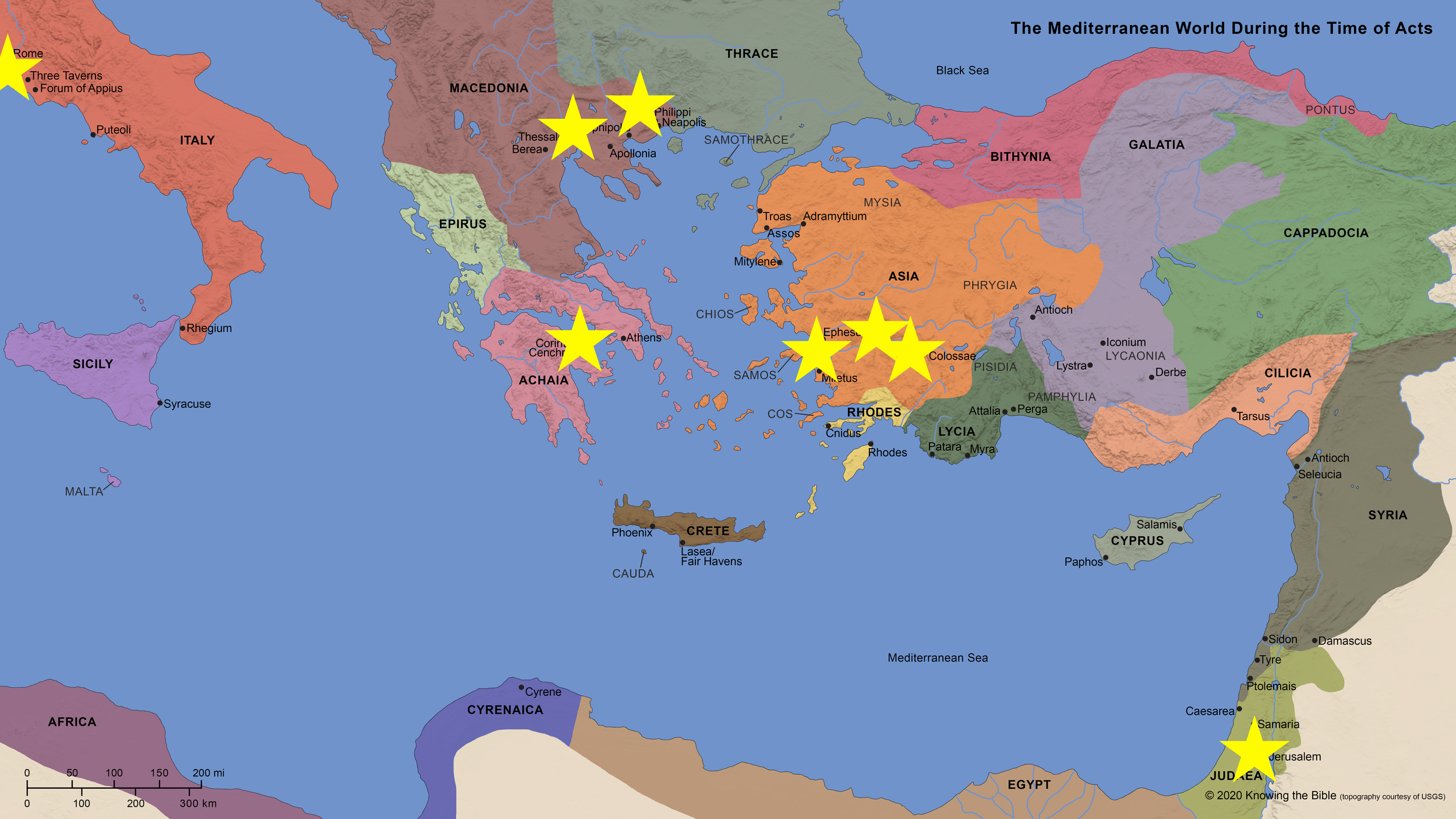
Yellow stars indicate where women were leaders in the early church. Often the biblical text explicitly notes that they led house churches, sometimes it is implied.

There was Mary, the mother of John Mark, (Acts 12:12) whose home was a house of prayer in Jerusalem. And there was Apphia in Colossae (Philemon 1-3), and Nympha (Colossians 4:15 ) and the church in her house in Laodicea. The Prominent Women (Acts 17:12) in Thessolonica don’t get named, unfortunately, but Paul notes that they were persuaded to join the Way of Christ, and it follows that they led others in turn. And in Philippi Paul urges Euodia and Syntyche (Philippians 4:2-3) to put aside their differences and remember how they struggled beside Paul in the work of the gospel. They and those whom they lead must be in the same mind in the Lord.

If we were to compare founding a church to giving birth, then maybe Paul was a midwife, who traveled around, supporting the birth of new churches, and the house church leaders were the new parents who nurtured and reared their baby churches and helped them grow. And these new parents were both women and men.

But then something happened to change the way the church operated. In the fourth century, the Christian church became the official state religion of the Roman Empire—going from a network of scrappy house churches to becoming a tool of the state. The church grew up, and moved out of homes to separate structures devoted to worship, and the leadership of the church changed.

Women were integral in raising the church from infancy, but once the church became more closely connected to the state, patriarchal cultural norms crept in, and women were pushed aside. As churches were built in the public space, the roles in that public sphere were considered fit only for men. So men became the priests and bishops, and women had to find other, less prominent ways to serve the church.

It’s almost like it’s bad for the church to become too closely intertwined with the state. When we do that, what we lose is our radical nature, our sense that Christ can transcend the divisions that we put between us as human beings, instead seeing each of us as children of God, none of us better or worse than the other.

“There is no longer Jew or Greek; there is no longer slave or free; there is no longer male and female, for all of you are one in Christ Jesus.”

Paul was at peak crankiness when he wrote that, but aren’t we glad he put ink to paper and did?

Even when Paul says things that are problematic to my modern sensibilities, or goes off on tangents that I think maybe he spends too much time fixated on, I am glad he wrote all the letters he did, teaching new believers, helping them grow in the Way of Christ.

Remember this was before the internet, these folks didn’t have cell phones, heck they didn’t even have phones that plugged into the wall, or access to a postal system. If Paul wanted to get a message to a church, either he had to go himself or send a letter with a messenger. Those were his only options.

And still, even with these limitations in technology, this new religion, Christianity, spread. Because the gospel is that electric, that radical. The way of Christ spoke to people, and they wanted to be part of it, to know more, to be in community with others who sought to relate to God in this new way.

Even if they had trouble figuring out the right ways to be in community, the gospel of Christ was strong enough to convince them to keep trying. And isn’t that what we are still doing today? Trying to figure out how best to be a community of faith that honors Christ and does Christ’s work in the world?

What if Paul were to write a letter to this church, what would he say? Would it be one of his cranky ones, where he has to get on to us about something? In what ways would he need to correct us? In what ways would be praise us? It’s something for us to think about, because we are all in this together, figuring out how to be the church in this time and place. And there will be things we get right, and there will be things we get wrong. But by the grace of God, may we continue to worship God and love one another, as best we can.

To the church of God that is in Homer, to those who are sanctified in Christ Jesus, called to be saints, together with all those who in every place call on the name of our Lord Jesus Christ: grace and peace to you from God and from the Lord Jesus Christ.

May we now pass the peace of Christ with one another.

Want to get an email when I publish a new post?

* indicates required

Intuit Mailchimp

I promise I will not share your information with anyone. Filling out this form means you will get an automated email from Mailchimp the day after I post anything to this blog. You can unsubscribe anytime! It won’t hurt my feelings. :)

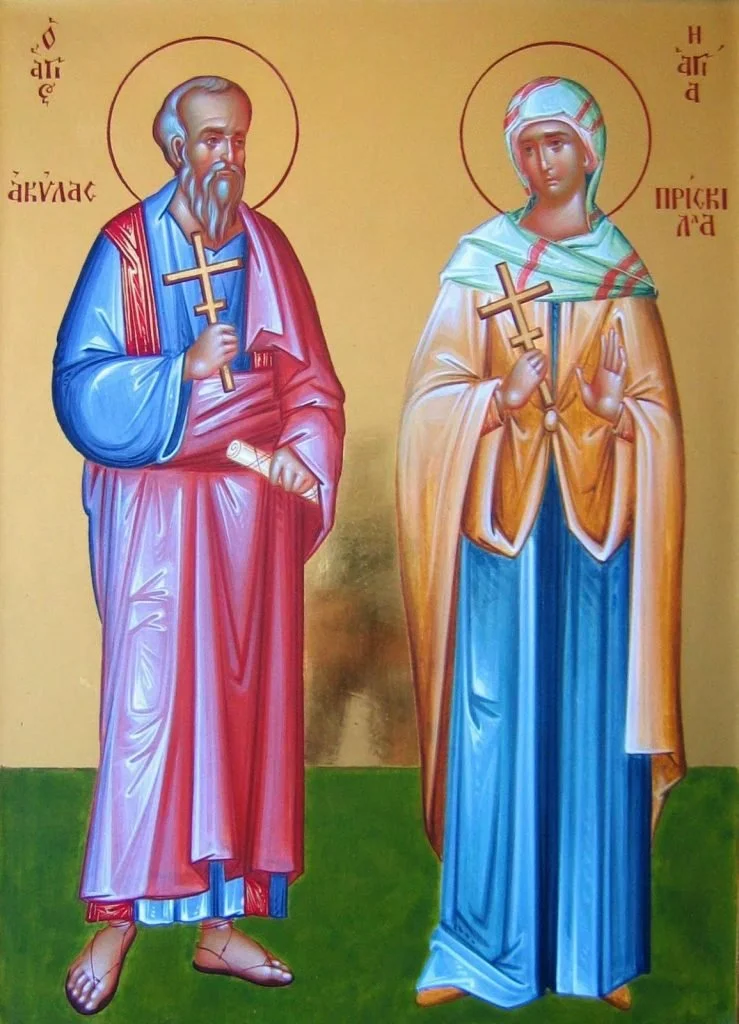
Prisca/Priscilla (and Aquila)

This is sermon #3 of 6 in my series on women leaders in the Gospels & the early church. Today’s focus is on Prisca, aka Priscilla, whose husband and ministry partner is Aquila.

--Rev. Stephanie Spitzer-Hanks, 6th Sunday in Easter, 2026, Homer Congregational Church, United Church of Christ, Homer, New York


If you prefer to watch instead of read the sermon, the video should begin at the beginning of the sermon.


Acts 18:1-27, abridged from The Voice

From Athens, Paul traveled to Corinth alone. He found a Jewish man there named Aquila, [who with] his wife Priscilla had recently come to Corinth from Italy because Claudius had banished all Jews from Rome. Paul visited them in their home and discovered they shared the same trade of tent making. He then became their long-term guest and joined them in their tentmaking business.

Each Sabbath Paul would engage both Jews and Greeks in debate in the synagogue in an attempt to persuade them of his message…Eventually, though, some of the Jewish people stopped listening and began insulting him. He shook the dust off his garments in protest.

Paul said, “I’ve done all I can for you. You are responsible for your own destiny before God. From now on, I will bring the good news to the outsiders!” He walked out of the synagogue and went next door to the home of an outsider who worshiped God. 

At the end of 18 months, Paul said goodbye to the believers in Corinth. He wanted to travel to the east and south to Syria by ship; so, accompanied by Priscilla and Aquila, …the three of them sailed east to Ephesus where Paul would leave Priscilla and Aquila. Paul [continued traveling]…visiting city after city…strengthening the disciples in each place.

Meanwhile, back in Ephesus, a Jew named Apollos made contact with the community of believers. He had been raised in Alexandria. Apollos was eloquent and well educated in the Hebrew Scriptures. He was partially instructed in the way of the Lord, and he added to his native eloquence a burning enthusiasm to teach about Jesus.

He taught accurately what he knew; but he had only understood part of the good news, specifically the baptism preached by John, the forerunner of Jesus. So, when Priscilla and Aquila heard him speak boldly in the synagogue, they discerned both his gift and his lack of full understanding. They took him aside and in private explained the way of God to him more accurately and fully. 

Apollos [traveled] west, into an area where Paul had recently been, to preach there…Upon his arrival, he was of great help to all…who had, by the grace of God, become believers.


Sermon Transcript

We continue in our series about women leaders in the Gospels and in the early church. So far we have explored the contributions of Mary Magdalene, Joanna, Susanna, who were disciples of Jesus and financial supporters of his ministry, and Lydia, whose enthusiastic embrace of the gospel prompted the establishment of a church in her house in Philippi.

This week, we turn our attention to a woman named Prisca, who also went by the nickname Priscilla. When she is mentioned in Acts and in the letters of Paul, she is always mentioned alongside her husband, Aquila.

The two of them are mentioned a total of six times, and four of those times, Priscilla is mentioned first, ahead of Aquila.

I mean, it is a big deal that she is named at all, considering alllll the women in the Bible who get the “daughter of so-and-so” or “so-and-so’s wife” treatment.

For comparison, consider Peter’s wife: he is a contemporary of Paul, who also was a leader in the early church, who also went on missionary journeys to found and encourage new churches. Peter has a wife—who even traveled with him—and we never ever get to know her name. Which leads us to think maybe she didn’t take an active role in the work Peter was doing in the world, preferring to stay in the background.

Yet we get to know Aquila *and* Prisca, so clearly she took an active role in their ministry. We never hear about one without the other. *And* four out of six times, Prisca is mentioned first. Why would that be?

No reason is given. Perhaps she had a stronger force of will, or maybe it was her superior intellect that brought her name to mind ahead of her husband’s. Maybe she was born to a higher social class? We just don’t know.

But as I’ve said time and again, the biblical authors chose their words carefully. Who gets mentioned and how, matters.

So what was special about Prisca?

Well, even though we read her name six times in the Bible, the mentions in Paul’s letters are brief—one or two verses of greeting within a passage where he greets lots of people whom he has worked with in all the various places he has traveled. Those mentions are like this one from 1 Corinthians:

“The churches of Asia send greetings. Aquila and Prisca, together with the church in their house, greet you warmly in the Lord.”

Or in 2 Timothy: “Greet Prisca and Aquila and the household of Onesiphorus.”

So, not a lot to go on there. But in his greeting in his letter to the Romans, Paul does add some interesting detail:

“Greet Prisca and Aquila, my coworkers in Christ Jesus, who risked their necks for my life, to whom not only I give thanks but also all the churches of the gentiles.”

What’s this about risking their necks for Paul? Who knows, Paul was always getting into trouble, it could have been anything. But whatever it was, Prisca and Aquila put themselves at risk in protecting Paul.


Paul thanks them, and adds the thanks of “also all the churches of the gentiles.” Which gives us a hint that this pair was influential not just in one house church in one city, but that they were well-known throughout the region.

We get the most information in the book of Acts, chapter 18, which Joanne read parts of for us. Let’s take a closer look at that passage.

We catch up with Paul in his interminable travels as he heads to Corinth, in the south of Greece. There he meets the married Jewish couple: Aquila & Priscilla. They had just been evicted from their home in Rome, “because Claudius had banished all Jews from Rome.”

But why did the emperor Claudius banish all the Jews from Rome? At this time very early in the Christian church, it was all very confusing—was Christianity a subset of Judaism? After all, Jesus had been Jewish, and all of his early followers were also Jewish. So there was conflict between Jews who followed Jesus and those that did not.

There was also conflict *within* Christian churches on whether and how to admit non-Jews—in the translation I am using today, these folks are called “outsiders,” but most translations use the term “Gentiles,” which just means “not-Jewish.” Should the non-Jewish folks be required to follow Jewish ways of living and worship, or should a new way be found to be a new kind of believer who follows Christ, regardless of one’s ethnic background?

So, there was a lot of conflict to go around. And it is probable that the disturbances between Jews who followed Jesus and those who did not got to be too much for the Roman authorities, so the emperor Claudius kicked them all out to maintain order.

This ban on Jews lapsed with the death of Claudius about 5 years later, and Jewish folks (both those who did and did not follow Jesus) began returning to the city, which is how Paul was able to send greetings to Prisca & Aquila in Rome just a few years after the events of our story today.

All that to say, Prisca & Aquila had been forced to leave Rome and the home they had made there, and Paul met them where they had settled temporarily in Corinth. It’s unclear whether they were already followers of Christ or whether Paul won them over. What is clear is that they all *really* hit it off. Turns out they were all in the same trade—tent making. Paul moved in with them and they all went into business together, making tents.

But you know Paul, he wasn’t in Corinth just to stitch some canvas together. He was there to preach the way of Christ! So, every Sabbath he would go down to the local synagogue and debate anyone who would engage with him, whether they were Jewish or Greek.

As time went on, the Jewish people at the synagogue tired of Paul’s relentless debating. The text says that “some of them stopped listening and began insulting him.” So, “He shook the dust off his garments in protest” and left.

I love that. “He shook the dust off his garments in protest.” It was a little like shouting, “I know when I’m not wanted!” before slamming the door on the way out.

But there is a precedent here—Paul’s dusting himself off echoes Jesus’s instructions to the Twelve in Matthew, when Jesus sent them out on mission. He gave them instructions on where and how they were to travel, and he ended with this: “If anyone will not welcome you or listen to your words, shake off the dust from your feet as you leave that house or town.”

Now, I don’t know who needs to hear this today, but let me tell you: it is ok to disengage from folks who refuse to engage in good faith with you. It is ok to step back and step away from situations and from people who do not welcome you, who insult you, who do not listen to you. It is ok to shake the dust from your clothes and just walk away. You do not need to spend any more of your time and energy on folks who return your good will with insults.

And so Paul had had enough of the folks in the synagogue and their refusal to listen and their insults. He said, “I’ve done all I can for you. You are responsible for your own destiny before God. From now on, I will bring the good news to the outsiders!” He walked out of the synagogue and went next door to the home of an outsider who worshiped God.” And where presumably he was given a warmer welcome.

This arrangement in Corinth—living with Priscilla and Aquila, working together to make tents during the week, and seeking out converts to the way of Christ on the weekends—it all lasted a year and a half.

Then Paul was ready to move on, and this time, Priscilla and Aquila traveled with him. The three of them traveled by boat from Corinth (which, again, is in the southern part of Greece) to Ephesus (which is in the eastern part of Turkey).

After staying just a short while with them, preaching in the synagogue there, Paul left the couple in Ephesus, while he continued on, “visiting city after city…strengthening the disciples in each place.”

Which would have been, like, his favorite thing to do.

While Paul was traipsing across the Middle East, Aquila and Priscilla were getting settled into Ephesus and founding the church there.

At some point, the community of believers in Ephesus was approached by a Jewish man named Apollos. Apollos was from Alexandria, a city that was world famous for its library and was widely regarded as a seat of higher learning. Apollos had clearly taken advantage of his city’s opportunities for scholarship, since he is described as “eloquent and well educated in the Hebrew Scriptures.”’

And he also was enthusiastic! He was ready to speak out with eloquence and elegance about Jesus!

But there was a problem: he had only learned part of the story. He lacked a full understanding of the way of Jesus. What he knew he spoke boldly and convincingly, but he only knew so much.

Priscilla and Aquila listened to Apollos speak in the synagogue, and they immediately read the room and thought, “Here is a guy who is smart, well-spoken, and eager. All he needs is a little tutoring.”

So, the text says “they took him aside and in private explained the way of God to him more accurately and fully.”

Let me underscore—it was *they* who pulled him aside and explained to him. And this is one of those instances where Priscilla’s name gets listed before Aquila’s. Perhaps because she was the one who was more active in doing the explaining?

This is an instance of a woman (alongside her partner) giving instruction to a man. This is significant, because 1) it would have been unusual at the time, and 2) in many churches today, it would still be unusual. But here, it happens, and no one seems troubled by the occurrence of a woman instructing a man in matters of theology.

In fact, Apollos seems to have taken it all rather well! After his private tutoring at the hands of Priscilla and Aquila, Apollos is ready to branch out on his own, following in the footsteps of Paul to another church where he could preach the gospel of Christ. The text says:

“Upon [Apollos’s] arrival, he was of great help to all in [that region] who had, by the grace of God, become believers. This gifted speaker publicly demonstrated, based on the Hebrew Scriptures, that the promised Anointed One is Jesus. Then, when the Jewish people there raised counterarguments, he refuted them with great power.”

Apollos went on to become as influential a leader in the early church as Paul. Paul mentions him several times in his letters as a fellow missionary who moved from church to church, city to city, preaching and inspiring believers.

But what if Priscilla and Aquila hadn’t pulled him aside that day? What if they hadn’t decided to help him learn? What if he had refused to listen? Things could have been really different if Prisca and Aquila had not stepped in and spoken up.

Sometimes we think we aren’t smart enough, or we won’t be able to find the right words, or we feel too self-conscious to speak up to another person about matters of faith, to share the effect that God has had on our own lives.

Priscilla and Aquila could easily have thought they weren’t right for the job of tutoring Apollos. After all, they were tentmakers, and Apollos was a scholar from one of the most famous universities around!

But speaking about our own experience of faith doesn’t take a college degree or specialized training. What it takes is courage and a willingness to step out of our comfort zones to tell someone how our faith has impacted our lives and our values and how our faith influences the decisions we make and the things we put our energy and time into. I mean, why would we keep something so significant to our lives a secret?

Now, I am not suggesting that you go knock on doors or stand on street corners passing out religious pamphlets. What I am saying is—be ready to share what matters to you with people who matter to you, when the opportunity arises.

I think that Stef helped some of you to make a good start of it when she asked the question, “Why do you choose to come to Homer Congregational Church?” She recorded those answers and made a video, a part of which she shared on our social media this past week, and there is more on our YouTube channel. It is absolutely worth a watch.

May it inspire you to reflect on why this church and your faith matters to you. And may we all have the boldness of Prisca and Aquila in speaking up when it matters, when we have important matters of faith to share, when it is the right thing to do.

But also remember: if you find yourself in spaces where your authentic self is met with hostility and insult, where your attempts at earnest dialogue are shut down, you can and should shake the dust off your clothes, walk out that door and into one that is open to you.

So let us go from here to wherever you go this week, with the courage of our convictions and a readiness to share with our neighbors and friends why your faith matters to you.

Amen!

Want to get an email when I publish a new post?

* indicates required

Intuit Mailchimp

I promise I will not share your information with anyone. Filling out this form means you will get an automated email from Mailchimp the day after I post anything to this blog. You can unsubscribe anytime! It won’t hurt my feelings. :)

Lydia

This is sermon #2 of 6 in my series on women leaders in the Gospels & the early church. Here we meet Lydia, who has always been a personal favorite of mine. More to come…

--Rev. Stephanie Spitzer-Hanks, 5th Sunday in Easter, 2026, Homer Congregational Church, United Church of Christ, Homer, New York


If you prefer to watch instead of read the sermon, the video should begin at the beginning of the sermon.


Acts 16:11-15

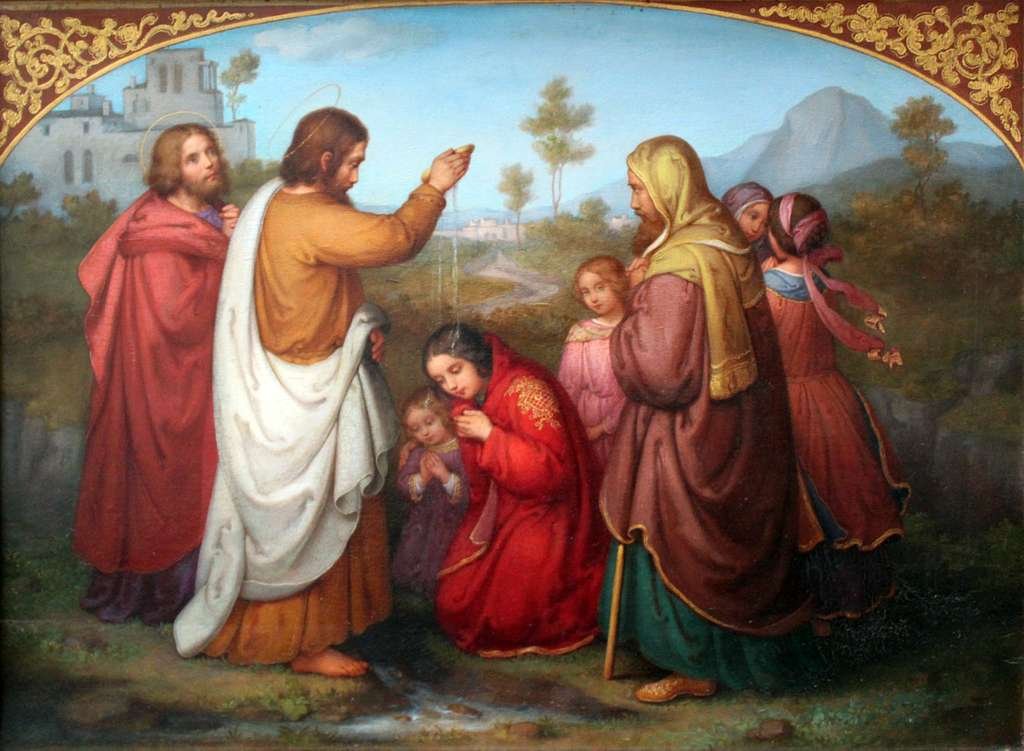
We [traveled to] Philippi, a Roman colony and one of Macedonia’s leading cities. We stayed in Philippi for several days. On the Sabbath day, we went outside the city walls to the nearby river, assuming that some Jewish people might be gathering for prayer. We found a group of women there, so we sat down and spoke to them. One of them, Lydia, was a business woman originally from Thyatira. She made a living buying and selling fine purple fabric. She was a true worshiper of God and listened to Paul with special interest. The Lord opened her heart to take in the message with enthusiasm. She and her whole household were baptized. Then Lydia urged us, saying, “If you believe I’m truly faithful to the Lord, please, you must come and stay at my home.” We couldn’t turn down her invitation.


Sermon Transcript

This is #2 in a series of 6 sermons about women leaders in the Gospels and the early church. Last week we learned a bit about some of Jesus’s disciples who were women: Joanna, Susanna, and Mary Magdalene, who was sent by Jesus as the apostle to the apostles. She was a pretty big deal.

This week we start in on the early church, where Paul’s fingerprints are all over everything—you almost cannot tell a story about the early church without also talking about Paul.

Paul had a habit of traveling to a new place, preaching, welcoming newcomers to the Way of Christ, helping to establish churches, often getting arrested, and later being released, and then moving on to do it all over again in a new place.

In the passage read for us today, that is exactly what he is up to. We catch up with him and his traveling companions as they head into Philippi, which is in what we now know as Greece. So this was the first time we are hearing about the gospel being preached in what we now call Europe.

On the Sabbath, Paul and his friends head down to the riverside, where they had heard that some Jewish people gathered in prayer. There was a group of women there, who included a woman named Lydia.

Now you can just tell right away that Lydia was a firecracker. She is originally from Thyatira, which was a city in the area we now know as Turkey, which was famous for dyeing purple cloth. Lydia brought these skills with her and set up her own business trading in purple fabric in Philippi. 

It is not specified how she was able to own her own business, which would *not* have been typical at all for women during that time. Was she a widow, who had inherited the business when her husband died? Maybe? We just don’t know. But we do know that she was probably fairly wealthy, since purple dye (which was made from glands from snails that lived in the Mediterranean Sea) was very expensive to make and to buy. Another tip off that she was wealthy is the fact that she employed her own household servants.

So, Lydia was among this group of women who had gathered at the riverside, where some Jewish folks had gathered to pray on the Sabbath. She is described as a “true worshiper of God.” Lydia may have been Jewish, or she may have just been attracted to and curious about the Jewish religion. Again, it’s not clear. But she was there for the prayer service, and she was ready to learn.

On that morning, as Paul spoke to those gathered there, the text says that “The Lord opened her heart to take in the message with enthusiasm.” 

A couple of weeks ago we read about the disciples on the road to Emmaus, and the text said that their “hearts burned within” them, when Jesus opened the scriptures to them. I wonder if this is a similar experience for Lydia: “The Lord opened her heart to take in the message with enthusiasm.”

I wonder what that might feel like?

The experience was so powerful for Lydia that she insisted on being baptized right then and there—and not just her, but she brought everyone who worked in her home along to be baptized, too.

And then, she was not going to let Paul and his companions go—she insisted that they come and stay in her home. I can just imagine her keeping Paul up half the night, asking him questions, soaking in everything he could teach her about the Way of Christ.

While Paul and his friends were staying with Lydia, he still went back and forth to the riverside, reaching more people with the gospel of Christ. 

Then Paul got into trouble over a slave girl that yelled at him every day, until he got so annoyed with her that he healed her of an evil spirit, just to shut her up. If you didn’t know, Paul had a little bit of a cranky personality.

Now the enslavers of this girl were angry with Paul, because they had been making money off the girl, who had been able to tell people’s fortunes—that is, until Paul cast the evil spirit from her. They were so mad that they had Paul and his friend Silas arrested, beaten, and thrown in jail.

Then there was this whole incident where Paul and Silas were keeping their cellmates up to all hours with their loud praying and hymn-singing—that is until there was an earthquake that broke all the doors open and unfastened all the prisoners’ chains.

The jailer woke up and saw that the prison doors were all wide open, and, knowing he will really be in for it with his boss for letting all the prisoners escape on his watch, he grabs his sword and is about to kill himself with it, but just at that moment, Paul pipes up, “Don’t hurt yourself, Mr. Jailer. We are all still in here!”

(If you haven’t already gotten the picture—Acts is a pretty action-packed book, full of some WILD stories.)

Then the jailer and *his* household convert to the Way of Christ, and *they* are all baptized. It’s a big night. In the morning, Paul and Silas are released from prison (legally, and without the aid of any earthquakes). 

And *then* we get the next and last mention of Lydia in the Bible: in the very last verse in this action-packed chapter, we read this:

“After leaving the prison they went to Lydia’s home; and when they had seen and encouraged the brothers and sisters there, they departed [from Philippi].”

In this one verse we learn that in the days since her own conversion and baptism in the river, a house church has begun to thrive in Lydia’s home. Her home was a meeting place for “the brothers and sisters” who had joined her in following the Way of Christ.

And this is how the gospel of Christ spread through the known world: Paul would blow into town, preaching, converting folks. A group of believers would start meeting in a home. Then Paul would move on, but the church would remain—worshiping and growing in faith and love for God and one another.

In the beginning of this new religion that we now call Christianity, there were no church buildings. No pews, no hymnals, no priests or pastors in robes and stoles. No institution as of yet. That came later.

What they had in the beginning was a group of believers, and someone who had a house they could meet in to pray, and sing, and share what they knew about God, and about the Way that Christ had shown them.

And some of those houses belonged to women. Lydia was one, and we will meet others over the next weeks.

I love Lydia for her enthusiasm. Just the words Luke uses to describe her: She listened to Paul “with special interest.” “The Lord opened her heart to take in the message *with enthusiasm.*” She “urged” them to stay with her. They “couldn’t turn her down.” 

This is a woman who knows what she wants and is not afraid to insist on it! And nobody is criticizing her for being too bossy or telling her to be quieter or more demure—she is being praised for it!

As a gal who has never been particularly meek or timid or submissive, I appreciate having Lydia held as a role model for outspoken women like me. Maybe some of you do, too.

Paul could get cranky in some of his letters, and for good reason, because a lot of these early churches had people disagreeing with one another, and they developed factions within the church that were threatening to tear it apart. Sounds familiar, right? Such problems still plague churches today.

But the letter he wrote to the church at Philippi—the church that Lydia was *instrumental* in founding—was full of joy and gratitude for them. He said:

“I thank my God for every remembrance of you, always in every one of my prayers for all of you, praying with joy for your partnership in the gospel from the first day until now. I am confident of this, that the one who began a good work in you will continue to complete it until the day of Jesus Christ.”

That reminds me of this church: of Homer Congregational Church.

Y’all have been on this green for a good long time. The people who started meeting here to worship way back in 1801 made a choice to “partner in the gospel” and by the grace of God, here we all are, 225 years later, still gathering on this green.

I know only a few of us get the printed worship guide on Sunday mornings, and I don’t know whose idea it was to print this on the bottom of the front page, but this is what it says:

“Grateful to the native peoples upon whose land we stand, we have gathered on this Green since 1801—Still Growing Deeper as We Do God’s Mission.” 

Paul’s words to the Philippians could just as well be addressed to you:

“I thank my God for every remembrance of you…praying with joy for your partnership in the gospel from the first day until now. I am confident of this, that the one who began a good work in you will continue to complete it until the day of Jesus Christ.”

You have had many leaders over the years. I really enjoy looking at the array of portraits of past ministers hanging on the other side of the wall behind me. Some really impressive beards.

And soon it will be time to welcome someone new. I know you are hoping it will be very soon, but there is still need for patience! I pray that your new pastor will have the enthusiasm of Lydia! And that you as a congregation continue to hold the gospel and one another close, and continue to joyfully work together and with your new pastor, when she or he comes at last.

I know many of you feel anxious and are ready for this in-between time to end. But try to remember that this is just one dip in this congregation’s 225 year journey so far! Keep the faith. Keep growing deeper as you do God’s mission, while you wait for your next Lydia, or maybe Paul.

But while we anticipate that day, may you continue to hold on to the blessing Paul gave to the Philippians, and that today I give to you:

“I am confident of this, that the one who began a good work in you will continue to complete it until the day of Jesus Christ.” Thanks be to God!

Want to get an email when I publish a new post?

* indicates required

Intuit Mailchimp

I promise I will not share your information with anyone. Filling out this form means you will get an automated email from Mailchimp the day after I post anything to this blog. You can unsubscribe anytime! It won’t hurt my feelings. :)

Mary Magdalene, Joanna, Susanna

This is the first of a series of sermons about women as leaders in the Gospels and in the early church. It was inspired by this sermon about the two disciples on the road to Emmaus. More sermons in this series to follow!

--Rev. Stephanie Spitzer-Hanks, 4th Sunday in Easter, 2026, Homer Congregational Church, United Church of Christ, Homer, New York

Ceballos Fernández, Lázaro A.. The Proclamation, from Art in the Christian Tradition, a project of the Vanderbilt University Divinity Library, Nashville, TN. https://act.library.vanderbilt.edu/artworks/59863 [retrieved April 27, 2026]. Original source: Beth Maczka, Beth@BethMaczka.com.


If you prefer to watch instead of read the sermon, the video should begin at the beginning of the sermon.


Luke 8:1-3

Soon afterward Jesus went on through one town and village after another, proclaiming and bringing the good news of the kingdom of God. The twelve were with him, as well as some women who had been cured of evil spirits and infirmities: Mary, called Magdalene, from whom seven demons had gone out, and Joanna, the wife of Herod’s steward Chuza, and Susanna, and many others, who ministered to them out of their own resources.


Sermon Transcript

Last week, as we were on the road to Emmaus, I rattled off a list of names of women who were Jesus’s disciples and also a list of women who were leaders in the early church.

But then I got to thinking, what if rattling off a long list isn’t the best way of learning about these women? We have time. We can spend some time learning about and being inspired by them, and along the way, we can also learn a thing or two about the early church—how Jesus’s teachings spread, churches were formed, what they got up to, what sort of challenges they faced. And maybe that would inspire us, too, as we do our best to be the church in this day and age.

So for the next six weeks that I am here in the pulpit, we are going to look more closely at some of these women, and the ministries they were part of, and the churches they helped lead.

This Sunday I thought it would make sense to begin with some of the women who were disciples of Jesus: Mary Magdalene, Joanna, and Susanna. And there were others! But this morning we will focus on these three.

We meet them early in Jesus’s ministry in Luke 8, which we are going to spend some time unpacking:

“Soon afterward Jesus went on through one town and village after another, proclaiming and bringing the good news of the kingdom of God. The twelve were with him, as well as some women who had been cured of evil spirits and infirmities: Mary, called Magdalene, from whom seven demons had gone out, and Joanna, the wife of Herod’s steward Chuza, and Susanna, and many others, who ministered to them out of their own resources.”

There’s a lot happening in these three verses.

First we learn something about the shape of Jesus’s ministry—the man really never stood still! He traveled, a LOT, “moving through one town and village after another.”

It is estimated that in the three years of Jesus’s ministry, he walked 3000 or so miles—maybe more! And yes, there are people in the world who have taken the time to note all of Jesus’s journeys, track the distances on a map, and tally up the results. I am going to take their word for it!

So he walked around 3000 miles, based on trips recorded in the Gospels. And he did all of this traveling to “proclaim and bring the good news of the kingdom of God” to anyone who would listen. This was who Jesus was—once he set out on his mission, he kept going, moving from place to place, preaching the kingdom of God anywhere he could draw a crowd—by the seaside, on a hilltop, on a plain.

He also had many conversations with folks on his travels. He was challenged by people who had other perspectives on the right way to be in relationship with God. He healed people.

And along the way people who witnessed all of this dropped what they had been doing and started following him. We call those people disciples, which is a Bible word for student or follower. And there got to be quite a few of them.

At one point Jesus decided to choose 12 men from this crowd of disciples, who were referred to from then on by the very original name: “The Twelve.”

These guys were disciples, but then Jesus gave them another role—he figured he could cover even more ground, heal more people, if he deputized the 12 to go out on their own, apart from Jesus. Their new role was that of “apostle”.

Now apostle is another Bible word—it just means “one who is sent on a mission.”

But even though the Twelve had been chosen from among a bunch of disciples and been sent out as apostles, they didn’t spend all their time away. They also spent a good bit of time being disciples, and learning from Jesus. It was sort of a dual role.

So, back to the passage we are looking at:

“Jesus went on through one town and village after another, proclaiming and bringing the good news of the kingdom of God. The twelve were with him, as well as some women who had been cured of evil spirits and infirmities:”

Ok so the Twelve were there, as were some women who had been cured of evil spirits and infirmities.

Infirmities we get, right? We pray all the time for ourselves and our loved ones who are facing illness. But being cured of evil spirits? That hits a little different, and I don’t know about you, but the whole idea of curing folks of evil spirits or casting out demons makes me uncomfortable. It feels a bit too Pentecostal for me.

When I read such passages, I do not imagine Jesus or his apostles casting out actual demons. For me, it’s a metaphor—a way for people in ancient times to express an idea they didn’t have any understanding of: things like mental illness, addiction, or what we might understand today as invisible or hidden disabilities: things like chronic pain, diabetes, or autism (to name a few).

They would have called all of these things “having an evil spirit” or “being possessed by a demon.” When Jesus healed someone, whether that illness was visible or invisible—it was a miraculous, life-changing encounter with the divine. And many people who had such healing, life-affirming encounters with Jesus, chose to become disciples and follow him in his travels, just to be close to him.

And that was the case for the women named here: Mary Magdalene—and by the way, Magdalene was not her last name. It just means she came from the town of Magdala.

But these three women: Mary Magdalene (who had not one but SEVEN demons cast out of her), and Joanna, and Susanna had been healed by Jesus in one way or another, and they became his disciples.

And not only did they learn from Jesus, they also funded his ministry from their own financial reserves.

Jesus was an itinerant preacher, traveling around Israel with a crowd of disciples—his ministry required some significant funds to keep going.

These three women: Mary, Joanna, Susanna—and many others—kept everyone fed and in tunics and sandals. They knew that the kingdom of God is not built on an empty stomach. It was their practical support—money in the offering plate—that kept Jesus’s ministry afloat.

These three women were with Jesus from early in his ministry, and two of the three are mentioned as witnessing Jesus’s death—Mary Magdalene and Joanna. So they clearly had staying power—they stuck with him through the years of travel, the bickering among the Twelve, the persecution from religious leaders, the confusing parables—all of it. They were there, supporting Jesus from early on to the end.

And Mary Magdalene didn’t give up even then—she is also mentioned—multiple times, and in all four gospels, as one of those who rose early on the third day after Jesus’s death, and discovered that his tomb was empty. Even Jesus’s death couldn’t keep her away. She was *extra* committed.

But here I am going to take a moment to talk about what the Bible *doesn’t* say about Mary Magdalene. Nowhere in the Bible does it say that Mary Magdalene was an adulteress, or a prostitute, or a fallen woman of any kind.

I have told you already all of the Bible passages that mention her: she was healed by Jesus of seven demons, she was a disciple of Jesus, she funded his ministry, she witnessed his death, she witnessed his resurrection. That’s it.

Yet there are rumors that persist about her being somehow sexually tainted. Where did that idea come from?

Well, we can thank Pope Gregory the first. He preached a sermon in the year of our Lord 591 that identified Mary Magdalene as the woman in Luke chapter 7 who washed Jesus’s feet with her tears, dried them with her hair, and then anointed his feet with perfume.

Now *that* woman *was* described in the Bible as sinful, and her sin was part of a whole conversation among some Pharisees who said that Jesus should not be letting her touch him.

But that woman was UNNAMED. We do not know her name. It definitely was not Mary Magdalene, or I’m pretty sure Luke would have said so.

Yet, Pope Gregory felt he knew better, and that the woman with the tears and the hair and the perfume was Mary Magdalene. And the misidentification stuck.

And then through the centuries, religious artists often depicted Mary Magdalene as a sexual object. And even in our modern times, if you’ve seen a movie or a play or read a novel based on Jesus’s life—odds are that Mary Magdalene was depicted as somehow tempting or seducing Jesus. It’s a whole trope.

But it’s wrong. It was wrong when Pope Gregory started this rumor back in the the 6th century. It wasn’t until 1969 that Pope Paul the 6th finally set the record straight and officially clarified that Mary Magdalene was indeed *not a prostitute.* But even so, her reputation as a woman with a checkered past persists.

Mary was not a woman with a checkered past. Unless you count being possessed by seven demons as checkered. Which I don’t.

And even if she had a checkered past, it really wouldn’t make a difference to me. I don’t care about who she did or didn’t have sex with. But a lot of people did care, and used that slander as a way of diminishing her value as a person, as a disciple of Christ.

So she was not a fallen woman. What she *was* was the first to discover the risen Lord, and the one whom Jesus tasked to tell the others. In John’s gospel, he tells it this way:

“Jesus said to her, “But go to my brothers and say to them, ‘I am ascending to my Father and your Father, to my God and your God.’ ” Mary Magdalene went and announced to the disciples, “I have seen the Lord,” and she told them that he had said these things to her.”

That is the image I chose for us to look at today—that of Mary Magdalene bringing the news to the disciples—news that she brought from Jesus himself—that he had risen from the dead.

She was the one chosen to tell them. She was the first person to see the risen Christ and the first to share the news of the resurrection with the disciples. She had been sent by Jesus on a mission: She was the apostle to the apostles!

———

What can we learn, how can we take inspiration from these women: Mary Magdalene, Joanna, Susanna?

Their experience of Jesus was life-affirming and life-changing—they gave their all to follow him. They spent their time learning from him. They funded his ministry. Their gifts enabled more people to have their suffering relieved by Jesus, their gifts enabled more people to hear Jesus’s message about the kingdom of God.

Aren’t these all things that we also could, or should, be doing? Shouldn’t our experiences of Jesus to draw us nearer to him? Shouldn’t we be taking in his words, learning from him how to live? And shouldn’t we be finding ways to fund and further Jesus’s mission in the world—relieving the suffering of others, and spreading the good news about the kingdom of God?

These women persisted in following him, through long days of travel, into situations where they were not necessarily welcomed. They followed Jesus all the way to his arrest, his trial. His execution.

Do we follow Jesus, even when it is hard?

Mary went and told the others about Jesus’s resurrection. Some of the disciples called her story a “idle tale.” I bet most of them didn’t believe her. But she didn’t care. She knew what she had experienced of the risen Christ, and she was not going to be quiet about it.

Are we quiet about Jesus, about who he is, about how our lives are changed because of his presence in our lives?

And there is also a lesson in here somewhere about not judging a person based on what other people say about them. For centuries, Mary’s reputation was smeared—perhaps because folks were threatened by her—by this woman whom Jesus chose to be his apostle? Perhaps the temptation to knock her down a peg or two—to put her in her place—was too great.

But let us not fall into that temptation. Let us not tear others down out of spite or jealousy. Let us not let any rumors about someone’s sexual history (or anything else) diminish their value as a person, as someone made in the image of God, like each of us are made in God’s image.

One of the reasons so many people were drawn to Jesus was that he had the ability to cut through all the noise and to see each person for who they truly are. He sees each one of us—each of us is a child of God, beloved by God, called to do God’s work in the word, with the gifts each of us have been given.

May we take Mary and Joanna and Susanna as our inspiration to answer God’s call on each of us to respond in faith and persist in following Jesus.

Amen.

Want to get an email when I publish a new post?

* indicates required

Intuit Mailchimp

I promise I will not share your information with anyone. Filling out this form means you will get an automated email from Mailchimp the day after I post anything to this blog. You can unsubscribe anytime! It won’t hurt my feelings. :)

The Other Disciple on the Road to Emmaus

This sermon was the inspiration for the sermon series to follow: at the beginning I wonder about whether the unnamed disciple (i.e. not Cleopas) on the road to Emmaus could have been a woman. Which later got me to thinking I need to spend some more time learning and preaching about the women who served as leaders in the Gospels and in the early church. Sermon series to follow!

--Rev. Stephanie Spitzer-Hanks, 3rd Sunday in Easter, 2026, Homer Congregational Church, United Church of Christ, Homer, New York

Hochhalter, Cara B.. On the Road to Emmaus, from Art in the Christian Tradition, a project of the Vanderbilt Divinity Library, Nashville, TN. https://diglib.library.vanderbilt.edu/act-imagelink.pl?RC=59269 [retrieved April 27, 2026]. Original source: Cara B. Hochhalter.


If you prefer to watch instead of read the sermon, the video should begin at the beginning of the sermon.


Luke 24:13-35, New Revised Standard Version Updated Edition

Now on that same day two of them were going to a village called Emmaus, about seven miles from Jerusalem, and talking with each other about all these things that had happened. While they were talking and discussing, Jesus himself came near and went with them, but their eyes were kept from recognizing him.

And he said to them, "What are you discussing with each other while you walk along?" They stood still, looking sad. Then one of them, whose name was Cleopas, answered him, "Are you the only stranger in Jerusalem who does not know the things that have taken place there in these days?"

He asked them, "What things?" They replied, "The things about Jesus of Nazareth, who was a prophet mighty in deed and word before God and all the people, and how our chief priests and leaders handed him over to be condemned to death and crucified him. But we had hoped that he was the one to redeem Israel. Yes, and besides all this, it is now the third day since these things took place.

"Moreover, some women of our group astounded us. They were at the tomb early this morning, and when they did not find his body there they came back and told us that they had indeed seen a vision of angels who said that he was alive. Some of those who were with us went to the tomb and found it just as the women had said, but they did not see him."

Then he said to them, "Oh, how foolish you are and how slow of heart to believe all that the prophets have declared! Was it not necessary that the Messiah should suffer these things and then enter into his glory?" Then beginning with Moses and all the prophets, he interpreted to them the things about himself in all the scriptures.

As they came near the village to which they were going, he walked ahead as if he were going on. But they urged him strongly, saying, "Stay with us, because it is almost evening and the day is now nearly over." So he went in to stay with them.

When he was at the table with them, he took bread, blessed and broke it, and gave it to them. Then their eyes were opened, and they recognized him, and he vanished from their sight. They said to each other, "Were not our hearts burning within us while he was talking to us on the road, while he was opening the scriptures to us?"

That same hour they got up and returned to Jerusalem, and they found the eleven and their companions gathered together. They were saying, "The Lord has risen indeed, and he has appeared to Simon!" Then they told what had happened on the road and how he had been made known to them in the breaking of the bread.


Sermon Transcript

This morning I’m going to talk about how sometimes our expectations keep us from being able to see what is really happening, or maybe our expectations blind us to what could be possible.

How many of you, when Lori read this story to us, in your mind’s eye you pictured three men—Jesus and the two disciples—walking and talking along the road to Emmaus? (Don’t worry, I won’t make you raise your hands!)

The text names one of the disciples—Cleopas (which is a man’s name)—but the other disciple not only doesn’t get named, but Luke also never uses any singular pronouns in this passage. It’s always “they” when referring to both of the disciples together, but Luke never says “he” when referring to either of them.

So why did we (and I include myself here) assume it was a male disciple? We are not alone in this assumption—every artistic rendering of this story I could find showed two dudes walking with Jesus. I picked this image because it is at least a bit ambiguous. That center figure *could* be a woman.

And the truth is, that second disciple could just as easily have been a woman as a man. She could very plausibly be Cleopas’s sister, or wife.

After all, the 12 disciples *were* all men, but they were just a subset of a larger group of disciples, which definitely included women. Cleopas even mentions his female co-disciples in this passage: he said to Jesus, “some women *of our group* astounded us” with their news about how they had gone to the tomb that morning and found it empty.

So clearly, the Three Marys (Mary Magdalene, Mary the mother of Jesus, and Mary of Clopas) were part of the group of disciples. Other female disciples named in the Gospels include: Joanna, Susanna, and the sisters at Bethany—Mary and Martha.

And then in the early church—there were several more women named as leaders in Acts and in Paul’s many letters. There was another Mary (the mother of John Mark), Priscilla, Chloe, Lydia, Apphia, Nympha, Euodia, Syntyche, and Junia—who were all mentioned by name as leaders in the church—and then there were the other women who were referred to by their relationships, such as the four daughters of Phillip, who were considered prophets.

So why did we assume both disciples on the road to Emmaus were men? Because that is what we expected to see.

Because it didn’t take too terribly long before the male leaders of the early church conformed to the cultural standards of their day and pushed the women aside, out of leadership roles. Because for most of Christian history it has been only men serving as pastors and priests.

Because some people pluck out from Paul’s letters—which he wrote to specific churches facing specific challenges—they pluck one or two verses that say that women should be silent in church. And they ignore all the other examples Paul gives of actual women *not being silent*—who were leaders of the church, whom he names in his letters, and of whom he speaks with respect and admiration.

So with all of that history behind us as well as the current practice in many other churches today being that women must be silent and submissive—it is completely understandable that we would not recognize that the second disciple could very well have been a woman.

———

But speaking of those two disciples, the question I have every single time I read this passage: How on earth could they not recognize Jesus?!? Like, how?!?

They are walking along, Jesus starts to overtake them (because of course Jesus is a speed walker). Jesus asks, “What are y’all talking about?”

And they are like, “Who are you, you total stranger?”

They have ABSOLUTELY NO IDEA who he is. These disciples. Of Jesus.

And they say, “We thought Jesus would be the messiah, the one who would come to redeem Israel (and through Israel, the whole world). But it turns out, we were wrong on that point, since he allowed the religious and political leaders to execute him three days ago.

“I mean, yeah, the women of our group have told us this wild tale about not finding his body in his tomb, and instead finding a bunch of angels who said that Jesus is alive. But how can that be? It is really too far fetched to be believed.”

That’s when Jesus calls them fools and then proceeds to give them a detailed theological discourse in which he walks them through every single instance in the Hebrew Law and Prophets that explains who the messiah is, specifically in relation to who Jesus is, and what his death really meant.

And still, through all of that, they had absolutely no idea who he was. Because they didn’t expect Jesus to show up like that. What they knew is that Jesus died three days ago. They expected that Jesus would stay dead. And can you blame them?

They didn’t expect that Jesus could rise from the dead, and walk alongside them. Jesus failed to meet their expectation of staying dead.

Friends, Jesus also fails to meet *our* expectations. But at the same time, he exceeds them.

What are some foolish expectations we have of Jesus?

Well there is the popular one, that if we just believe in Jesus, then life will be easy. That if we follow Jesus, we will be blessed with wealth, and health, and a good parking spot at the mall.

Jesus promises none of those things. So if that is what we expect from him, he will fail to meet those expectations.

Some folks expect Jesus to be vengeful and to sanction violence in his name. The current Secretary of Defense thinks this. He prays prayers of retribution in worship services held at the Pentagon. He expects that Jesus will bless war, and he is not alone in thinking this. Will Jesus fulfill this expectation? I don’t think so, and neither does the Pope. (To be clear, I don’t always agree with the Pope, but on this point, I do.)

So what should we expect of Jesus? We should expect him to surprise us, to show up in surprising ways, in ways that we maybe cannot imagine could be possible. I don’t think Jesus *means* to be sneaky, and catch us out. It’s just that we often try to constrain him with our expectations, and so when we look where we expect him to be, then he is not there.

So,where can we expect to see Jesus? Well, he did give some pretty clear direction on this point. In Matthew 25, Jesus was explainig how things would go at his final judgment, and he says that those who will inherit the kingdom of God will be the ones who served him during their lifetimes. He said:

I was hungry and you gave me food, I was thirsty and you gave me something to drink, I was a stranger and you welcomed me, I was naked and you gave me clothing, I was sick and you took care of me, I was in prison and you visited me.

So, if we are looking for Jesus, we can always find him among the poor, the hungry, the stranger, the sick, the incarcerated. With the sad, with the lonely, with the grieving, with the dying.

He also pretty clearly said that whenever we bless bread and break it and share it with one another, that he would be there. So maybe that’s why the light bulb finally clicked on when Jesus sat with those two disciples at table, and Jesus blessed the bread, and broke it. Then they knew who he was.

And that is when they remembered that their hearts had burned within them when Jesus had been speaking with them earlier, when he had “opened the scriptures” to them. What does that feel like—to have one’s heart burn within? Has your heart ever burned within you? What were the circumstances of that?

I think it must not be so common an experience. Not the kind of thing that happens every day. I think the experience of being faced with a truth so whole, so complete, so life-changing that it is not enough for your brain to simply process this truth. You also feel it in your heart, it burns within your soul. I think most of us probably only experience that a few times in our lives.

But that is what those two disciples felt, and could it be that you or I could feel it, too? Or at least, could you imagine what that might feel like, to finally see Jesus when you weren’t expecting it, to be so surprised by the joy of resurrection, that your life must be forever changed.

We have to stop trying to constrain Jesus with our small-minded and foolish expectations of him. We have to stop living as though he is there to serve our own ends, but to understand that we will find Jesus in the unexpected, we will find him in relationship with others, in moments of connection, in moments of joy.

Where might you recognize Jesus this week? Where can you expect to find him? In the face of a stranger in need? In the face of a friend whose life is falling apart? In your own dark moments of grief? In the joy of seeing a new baby? In the buds on the trees, and the bulbs breaking forth from underground? In the communion of sharing a meal? Where might you encounter the risen Christ?

Jesus doesn’t mean to be sneaky. We can find him. We just have to remember where to look, and to be open to finding him where we least expect.

Want to get an email when I publish a new post?

* indicates required

Intuit Mailchimp

I promise I will not share your information with anyone. Filling out this form means you will get an automated email from Mailchimp the day after I post anything to this blog. You can unsubscribe anytime! It won’t hurt my feelings. :)