
Mary Magdalene, Joanna, Susanna
This is the first of a series of sermons about women as leaders in the Gospels and in the early church. It was inspired by this sermon about the two disciples on the road to Emmaus. More sermons in this series to follow!
--Rev. Stephanie Spitzer-Hanks, 4th Sunday in Easter, 2026, Homer Congregational Church, United Church of Christ, Homer, New York
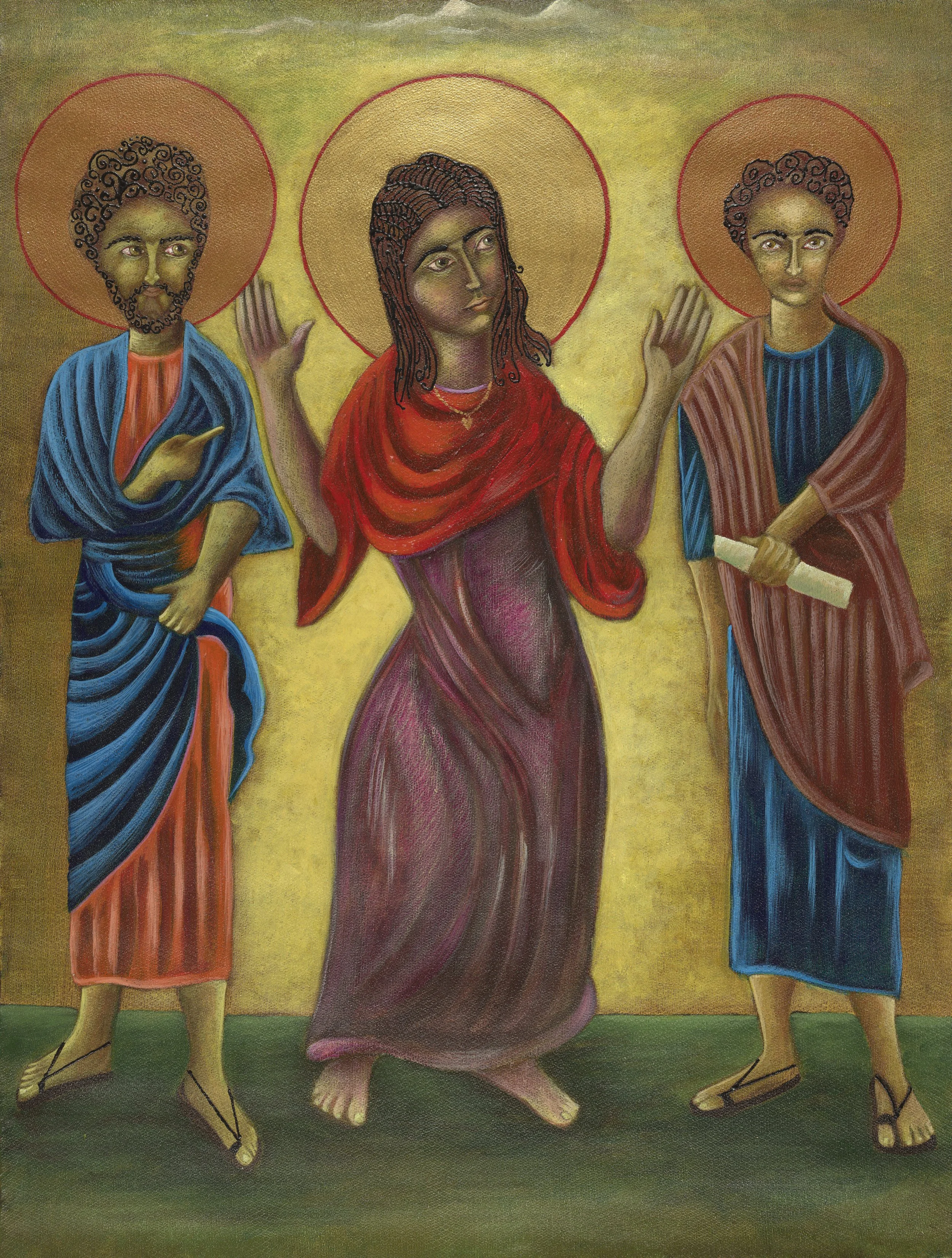
Ceballos Fernández, Lázaro A.. The Proclamation, from Art in the Christian Tradition, a project of the Vanderbilt University Divinity Library, Nashville, TN. https://act.library.vanderbilt.edu/artworks/59863 [retrieved April 27, 2026]. Original source: Beth Maczka, Beth@BethMaczka.com.
Luke 8:1-3
Soon afterward Jesus went on through one town and village after another, proclaiming and bringing the good news of the kingdom of God. The twelve were with him, as well as some women who had been cured of evil spirits and infirmities: Mary, called Magdalene, from whom seven demons had gone out, and Joanna, the wife of Herod’s steward Chuza, and Susanna, and many others, who ministered to them out of their own resources.
Sermon Transcript
Last week, as we were on the road to Emmaus, I rattled off a list of names of women who were Jesus’s disciples and also a list of women who were leaders in the early church.
But then I got to thinking, what if rattling off a long list isn’t the best way of learning about these women? We have time. We can spend some time learning about and being inspired by them, and along the way, we can also learn a thing or two about the early church—how Jesus’s teachings spread, churches were formed, what they got up to, what sort of challenges they faced. And maybe that would inspire us, too, as we do our best to be the church in this day and age.
So for the next six weeks that I am here in the pulpit, we are going to look more closely at some of these women, and the ministries they were part of, and the churches they helped lead.
This Sunday I thought it would make sense to begin with some of the women who were disciples of Jesus: Mary Magdalene, Joanna, and Susanna. And there were others! But this morning we will focus on these three.
We meet them early in Jesus’s ministry in Luke 8, which we are going to spend some time unpacking:
“Soon afterward Jesus went on through one town and village after another, proclaiming and bringing the good news of the kingdom of God. The twelve were with him, as well as some women who had been cured of evil spirits and infirmities: Mary, called Magdalene, from whom seven demons had gone out, and Joanna, the wife of Herod’s steward Chuza, and Susanna, and many others, who ministered to them out of their own resources.”
There’s a lot happening in these three verses.
First we learn something about the shape of Jesus’s ministry—the man really never stood still! He traveled, a LOT, “moving through one town and village after another.”
It is estimated that in the three years of Jesus’s ministry, he walked 3000 or so miles—maybe more! And yes, there are people in the world who have taken the time to note all of Jesus’s journeys, track the distances on a map, and tally up the results. I am going to take their word for it!
So he walked around 3000 miles, based on trips recorded in the Gospels. And he did all of this traveling to “proclaim and bring the good news of the kingdom of God” to anyone who would listen. This was who Jesus was—once he set out on his mission, he kept going, moving from place to place, preaching the kingdom of God anywhere he could draw a crowd—by the seaside, on a hilltop, on a plain.
He also had many conversations with folks on his travels. He was challenged by people who had other perspectives on the right way to be in relationship with God. He healed people.
And along the way people who witnessed all of this dropped what they had been doing and started following him. We call those people disciples, which is a Bible word for student or follower. And there got to be quite a few of them.
At one point Jesus decided to choose 12 men from this crowd of disciples, who were referred to from then on by the very original name: “The Twelve.”
These guys were disciples, but then Jesus gave them another role—he figured he could cover even more ground, heal more people, if he deputized the 12 to go out on their own, apart from Jesus. Their new role was that of “apostle”.
Now apostle is another Bible word—it just means “one who is sent on a mission.”
But even though the Twelve had been chosen from among a bunch of disciples and been sent out as apostles, they didn’t spend all their time away. They also spent a good bit of time being disciples, and learning from Jesus. It was sort of a dual role.
So, back to the passage we are looking at:
“Jesus went on through one town and village after another, proclaiming and bringing the good news of the kingdom of God. The twelve were with him, as well as some women who had been cured of evil spirits and infirmities:”
Ok so the Twelve were there, as were some women who had been cured of evil spirits and infirmities.
Infirmities we get, right? We pray all the time for ourselves and our loved ones who are facing illness. But being cured of evil spirits? That hits a little different, and I don’t know about you, but the whole idea of curing folks of evil spirits or casting out demons makes me uncomfortable. It feels a bit too Pentecostal for me.
When I read such passages, I do not imagine Jesus or his apostles casting out actual demons. For me, it’s a metaphor—a way for people in ancient times to express an idea they didn’t have any understanding of: things like mental illness, addiction, or what we might understand today as invisible or hidden disabilities: things like chronic pain, diabetes, or autism (to name a few).
They would have called all of these things “having an evil spirit” or “being possessed by a demon.” When Jesus healed someone, whether that illness was visible or invisible—it was a miraculous, life-changing encounter with the divine. And many people who had such healing, life-affirming encounters with Jesus, chose to become disciples and follow him in his travels, just to be close to him.
And that was the case for the women named here: Mary Magdalene—and by the way, Magdalene was not her last name. It just means she came from the town of Magdala.
But these three women: Mary Magdalene (who had not one but SEVEN demons cast out of her), and Joanna, and Susanna had been healed by Jesus in one way or another, and they became his disciples.
And not only did they learn from Jesus, they also funded his ministry from their own financial reserves.
Jesus was an itinerant preacher, traveling around Israel with a crowd of disciples—his ministry required some significant funds to keep going.
These three women: Mary, Joanna, Susanna—and many others—kept everyone fed and in tunics and sandals. They knew that the kingdom of God is not built on an empty stomach. It was their practical support—money in the offering plate—that kept Jesus’s ministry afloat.
These three women were with Jesus from early in his ministry, and two of the three are mentioned as witnessing Jesus’s death—Mary Magdalene and Joanna. So they clearly had staying power—they stuck with him through the years of travel, the bickering among the Twelve, the persecution from religious leaders, the confusing parables—all of it. They were there, supporting Jesus from early on to the end.
And Mary Magdalene didn’t give up even then—she is also mentioned—multiple times, and in all four gospels, as one of those who rose early on the third day after Jesus’s death, and discovered that his tomb was empty. Even Jesus’s death couldn’t keep her away. She was *extra* committed.
But here I am going to take a moment to talk about what the Bible *doesn’t* say about Mary Magdalene. Nowhere in the Bible does it say that Mary Magdalene was an adulteress, or a prostitute, or a fallen woman of any kind.
I have told you already all of the Bible passages that mention her: she was healed by Jesus of seven demons, she was a disciple of Jesus, she funded his ministry, she witnessed his death, she witnessed his resurrection. That’s it.
Yet there are rumors that persist about her being somehow sexually tainted. Where did that idea come from?
Well, we can thank Pope Gregory the first. He preached a sermon in the year of our Lord 591 that identified Mary Magdalene as the woman in Luke chapter 7 who washed Jesus’s feet with her tears, dried them with her hair, and then anointed his feet with perfume.
Now *that* woman *was* described in the Bible as sinful, and her sin was part of a whole conversation among some Pharisees who said that Jesus should not be letting her touch him.
But that woman was UNNAMED. We do not know her name. It definitely was not Mary Magdalene, or I’m pretty sure Luke would have said so.
Yet, Pope Gregory felt he knew better, and that the woman with the tears and the hair and the perfume was Mary Magdalene. And the misidentification stuck.
And then through the centuries, religious artists often depicted Mary Magdalene as a sexual object. And even in our modern times, if you’ve seen a movie or a play or read a novel based on Jesus’s life—odds are that Mary Magdalene was depicted as somehow tempting or seducing Jesus. It’s a whole trope.
But it’s wrong. It was wrong when Pope Gregory started this rumor back in the the 6th century. It wasn’t until 1969 that Pope Paul the 6th finally set the record straight and officially clarified that Mary Magdalene was indeed *not a prostitute.* But even so, her reputation as a woman with a checkered past persists.
Mary was not a woman with a checkered past. Unless you count being possessed by seven demons as checkered. Which I don’t.
And even if she had a checkered past, it really wouldn’t make a difference to me. I don’t care about who she did or didn’t have sex with. But a lot of people did care, and used that slander as a way of diminishing her value as a person, as a disciple of Christ.
So she was not a fallen woman. What she *was* was the first to discover the risen Lord, and the one whom Jesus tasked to tell the others. In John’s gospel, he tells it this way:
“Jesus said to her, “But go to my brothers and say to them, ‘I am ascending to my Father and your Father, to my God and your God.’ ” Mary Magdalene went and announced to the disciples, “I have seen the Lord,” and she told them that he had said these things to her.”
That is the image I chose for us to look at today—that of Mary Magdalene bringing the news to the disciples—news that she brought from Jesus himself—that he had risen from the dead.
She was the one chosen to tell them. She was the first person to see the risen Christ and the first to share the news of the resurrection with the disciples. She had been sent by Jesus on a mission: She was the apostle to the apostles!
———
What can we learn, how can we take inspiration from these women: Mary Magdalene, Joanna, Susanna?
Their experience of Jesus was life-affirming and life-changing—they gave their all to follow him. They spent their time learning from him. They funded his ministry. Their gifts enabled more people to have their suffering relieved by Jesus, their gifts enabled more people to hear Jesus’s message about the kingdom of God.
Aren’t these all things that we also could, or should, be doing? Shouldn’t our experiences of Jesus to draw us nearer to him? Shouldn’t we be taking in his words, learning from him how to live? And shouldn’t we be finding ways to fund and further Jesus’s mission in the world—relieving the suffering of others, and spreading the good news about the kingdom of God?
These women persisted in following him, through long days of travel, into situations where they were not necessarily welcomed. They followed Jesus all the way to his arrest, his trial. His execution.
Do we follow Jesus, even when it is hard?
Mary went and told the others about Jesus’s resurrection. Some of the disciples called her story a “idle tale.” I bet most of them didn’t believe her. But she didn’t care. She knew what she had experienced of the risen Christ, and she was not going to be quiet about it.
Are we quiet about Jesus, about who he is, about how our lives are changed because of his presence in our lives?
And there is also a lesson in here somewhere about not judging a person based on what other people say about them. For centuries, Mary’s reputation was smeared—perhaps because folks were threatened by her—by this woman whom Jesus chose to be his apostle? Perhaps the temptation to knock her down a peg or two—to put her in her place—was too great.
But let us not fall into that temptation. Let us not tear others down out of spite or jealousy. Let us not let any rumors about someone’s sexual history (or anything else) diminish their value as a person, as someone made in the image of God, like each of us are made in God’s image.
One of the reasons so many people were drawn to Jesus was that he had the ability to cut through all the noise and to see each person for who they truly are. He sees each one of us—each of us is a child of God, beloved by God, called to do God’s work in the word, with the gifts each of us have been given.
May we take Mary and Joanna and Susanna as our inspiration to answer God’s call on each of us to respond in faith and persist in following Jesus.
Amen.