
The Church in Her House
This is sermon #4 of 6 in my series on women leaders in the Gospels & the early church. Here we will learn about the additional women who were leaders of house churches, plus the wider question of how the early church figured out how to be the Church.
--Rev. Stephanie Spitzer-Hanks, 7th Sunday in Easter, 2026, Homer Congregational Church, United Church of Christ, Homer, New York
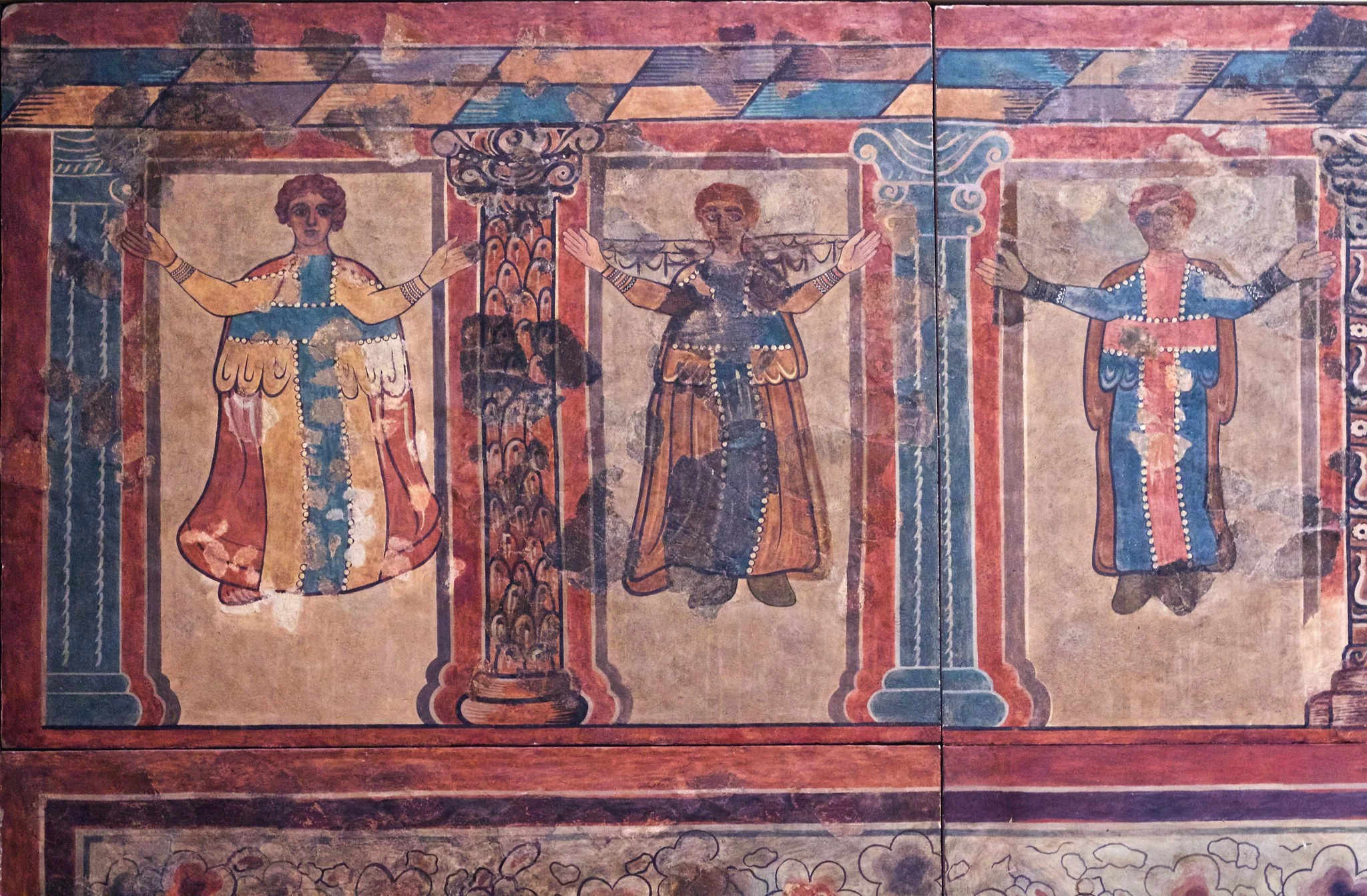
Painted walls from Lullingstone Roman Villa, 4th cent. AD, Lullingstone, Kent. Photo by Nick Thompson. https://flic.kr/p/DT5xoM
1 Corinthians 1:10-13 (NRSVUE)
Now I appeal to you, sisters and brothers, by the name of our Lord Jesus Christ, that all of you be in agreement and that there be no divisions among you but that you be knit together in the same mind and the same purpose. For it has been made clear to me by Chloe’s people that there are quarrels among you, my brothers and sisters. What I mean is that each of you says, “I belong to Paul,” or “I belong to Apollos,” or “I belong to Cephas,” or “I belong to Christ.” Has Christ been divided? Was Paul crucified for you? Or were you baptized in the name of Paul?
Sermon Transcript
We continue in our series about women leaders in the Gospels and in the early church. So far we have explored the contributions of Mary Magdalene, Joanna, and Susanna, who were disciples of Jesus and financial supporters of his ministry.
And in the early church so far we have learned about Lydia, whose enthusiastic embrace of the gospel prompted the establishment of a church in her house in Philippi, and then Prisca & her husband Aquila, who were co-workers in the gospel with Paul in multiple cities.
Our list of names grows by the week! And today I am going to add six more names to the list of women who were leaders in the early church, who opened their own homes as leaders of house churches.
We’ve been on this journey of learning about the early church—how it was founded, how it spread, and we’ve found that almost every story about the early church includes Paul. It is estimated that he traveled more than 10,000 miles on his missionary journeys—some of it in a boat, but a lot of it on foot. The man was tireless.
As I’ve said before, Paul had a habit of traveling to a new place, finding a place to preach the gospel of Christ, attracting converts to this new Way of Jesus, establishing churches in the homes of these new converts, and often getting arrested before he moved on to a new town to do it all over again.
And along the way, he would make time to write letters back to those churches that he had founded. Many of those letters were copied and passed around and saved and collected to form a good chunk of our Bible. But why did he write all of these letters to all of these churches? Mainly because he thought they were going about things in the wrong way.
I mean, he also wanted to encourage these new believers, and guide them, and give them more matters of faith to chew on so that they could mature as believers. Those are things he did in his letters. But often, he would get wind of conflicts and factions within house churches or between churches in the same city, and he would write to clear things up and get the churches back on track.
You have to understand, they were really making up this new religion as they went. I mean, of course, they were inspired by God and the teachings of Jesus, but logistically how that all was supposed to work in practice as a new way of relating to God and one another as communities of faith? They were figuring it out as they went.
And it was not just Paul who was traveling and preaching and guiding new churches—there were other people doing this work, too. Like Peter (who, confusingly, also went by Simon and by Cephas), and Apollos (whom we met last week, when Priscilla and Aquila pulled him aside and instructed him more fully in the Way of Christ.) And certainly there were other itinerant preachers who made the rounds throughout the Roman Empire, bringing good words to the churches, but also maybe confusing them a bit. Because different preachers bring different perspectives, right? The same is true today.
And that was what was happening in the text Joanne read today, from Paul’s letter to the church in Corinth:
“Now I appeal to you, brothers and sisters, by the name of our Lord Jesus Christ, that all of you be in agreement and that there be no divisions among you but that you be knit together in the same mind and the same purpose. For it has been made clear to me by Chloe’s people that there are quarrels among you, my brothers and sisters. What I mean is that each of you says, “I belong to Paul,” or “I belong to Apollos,” or “I belong to Cephas,” or “I belong to Christ.” Has Christ been divided? Was Paul crucified for you? Or were you baptized in the name of Paul?”
It seems that in Corinth, “Chloe’s people,” that is, the church that Chloe led in her house, have been snitching to Paul, that the churches in Corinth have split into factions. Some of the new believers there claim to “belong to” Paul, others to Apollos, others to Cephas, and still others say, “I belong to Christ.”
Paul comes down firmly in the “I belong to Christ” camp. One thing you can say about Paul: he was not interested in creating a cult of personality around himself. He always acknowledged Christ and the cross as central. He rather saltily asks, “Was Paul crucified for you? Or were you baptized in the name of Paul?” Of course, the answer is no. It was not Paul, but Christ who was crucified, and they were all baptized in the name of Jesus. Really, you would think they would remember that.
But, then as now, it is easy to fall into the trap of placing one’s allegiance in a leader or a movement that has captured our attention in this present moment, rather than in Jesus, whose presence endures, to be sure, but who might be less immediate to us, less tangible. Easier to ignore.
So the churches in Corinth were arguing, but this sort of thing was not unique to Corinth. All of the churches were arguing amongst themselves about something.
But what sort of things did they argue about? A reallllly big one was the question of how to integrate Gentiles (or non-Jews) into this new religion, all of whose adherents in the beginning were Jewish. There were quite a few Gentiles who were interested in Jesus, and Paul and Peter and Apollos had all preached inclusion of non-Jews.
But the question kept coming up: Did non-Jews who wanted to follow Jesus need to follow Jewish practices? Jesus had been a Jew, who had followed Jewish practice. It was a big question, and one that Paul spent a LOT of time answering.
In his letter to the Galatians he gets downright angry with them. In chapter 3 verse 1 he says, “You foolish Galatians! Who has bewitched you?” Remember, Paul had a tendency to get pretty cranky sometimes.
It turns out that after Paul left the church he helped the Galatians found, some different folks came and decided it would be a good idea to impose Jewish laws and customs on the Gentile members of the congregation, even going so far as to say that the male Gentile believers needed to be circumcised! You can imagine how well received that idea was.
Paul put the kibosh on that and told them that they couldn’t be more wrong. Paul had taught them a faith based on grace and love, not on rules and regulations. And he was ticked off that they had thrown away his teaching about the freedom that the love Christ has for each of us brings—a freedom to love one another as Christ loves us, a love that transcends the divisions that we like to make between one another.
Toward the end of the chapter that Paul began by calling the Galatians foolish, is one of the most quoted verses from all of his letters. He wrote:
“There is no longer Jew or Greek; there is no longer slave or free; there is no longer male and female, for all of you are one in Christ Jesus.”
This verse really stands out, because it is so radical. Paul said that “in Christ Jesus we are all children of God through faith.” When we make distinctions between Jew or Greek, or slave or free, or male or female, we lose sight of how God sees us—as all children of God, none of us better or more privileged in the eyes of God than the other.
You can see how this would be a radical idea! And a difficult one to wrap their minds around, as it continues to be difficult for us to wrap our minds around today.
But Paul insists that “There is no longer Jew or Greek; there is no longer slave or free; there is no longer male and female, for all of you are one in Christ Jesus.”
Jesus had talked with and welcomed all sorts of people, including non-Jewish folks, including disabled folks, including the poor, including women. And Paul was not going to let anyone forget that.
And the early church was a place where women could thrive, even as leaders! And this was not often true for women in the Roman Empire at the time. Roman culture was patriarchal—it was only men who could hold office and vote, and women were largely expected to keep to the home.
Now, there were exceptions. There were some circumstances where women could own their own property and run their own businesses. For example, there was Lydia, who owned her own business in trading purple cloth. But by and large, women were expected to play their traditional role in staying home and running the household. The home was the woman’s sphere of influence.
But since the early churches met and worshiped *in homes*, this worked out well for women like Chloe in Corinth, and Lydia in Philippi, and Priscilla, who along with her husband Aquila, hosted a church in their home in Corinth, and later in Ephesus, and eventually in Rome. Since the home was where women were *supposed* to lead, it makes sense that women *would* lead churches located within their homes.
Now, I don’t want to imply that it was *only* women who led house churches in the early church. There were men who were leaders. Of course, there were. But it was part of the radical nature of this new religion—that it was egalitarian in calling both women and men to full participation in the life of the church.
And there were other women who led house churches, besides the ones I’ve already named. This was not a fluke thing in one or two cities, but female leadership in the early church was seen throughout the whole area that Paul traveled.
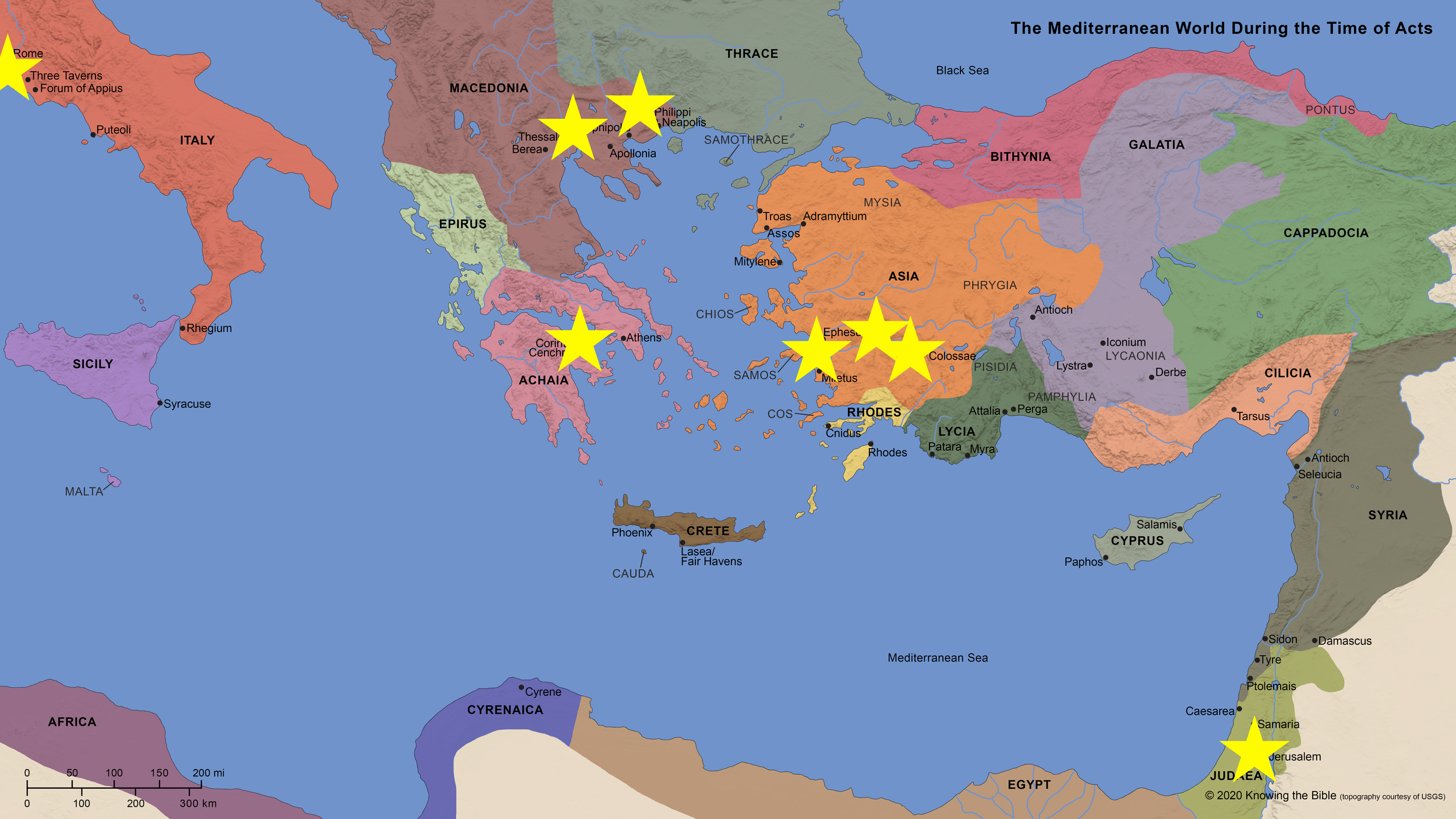
Yellow stars indicate where women were leaders in the early church. Often the biblical text explicitly notes that they led house churches, sometimes it is implied.
There was Mary, the mother of John Mark, (Acts 12:12) whose home was a house of prayer in Jerusalem. And there was Apphia in Colossae (Philemon 1-3), and Nympha (Colossians 4:15 ) and the church in her house in Laodicea. The Prominent Women (Acts 17:12) in Thessolonica don’t get named, unfortunately, but Paul notes that they were persuaded to join the Way of Christ, and it follows that they led others in turn. And in Philippi Paul urges Euodia and Syntyche (Philippians 4:2-3) to put aside their differences and remember how they struggled beside Paul in the work of the gospel. They and those whom they lead must be in the same mind in the Lord.
If we were to compare founding a church to giving birth, then maybe Paul was a midwife, who traveled around, supporting the birth of new churches, and the house church leaders were the new parents who nurtured and reared their baby churches and helped them grow. And these new parents were both women and men.
But then something happened to change the way the church operated. In the fourth century, the Christian church became the official state religion of the Roman Empire—going from a network of scrappy house churches to becoming a tool of the state. The church grew up, and moved out of homes to separate structures devoted to worship, and the leadership of the church changed.
Women were integral in raising the church from infancy, but once the church became more closely connected to the state, patriarchal cultural norms crept in, and women were pushed aside. As churches were built in the public space, the roles in that public sphere were considered fit only for men. So men became the priests and bishops, and women had to find other, less prominent ways to serve the church.
It’s almost like it’s bad for the church to become too closely intertwined with the state. When we do that, what we lose is our radical nature, our sense that Christ can transcend the divisions that we put between us as human beings, instead seeing each of us as children of God, none of us better or worse than the other.
“There is no longer Jew or Greek; there is no longer slave or free; there is no longer male and female, for all of you are one in Christ Jesus.”
Paul was at peak crankiness when he wrote that, but aren’t we glad he put ink to paper and did?
Even when Paul says things that are problematic to my modern sensibilities, or goes off on tangents that I think maybe he spends too much time fixated on, I am glad he wrote all the letters he did, teaching new believers, helping them grow in the Way of Christ.
Remember this was before the internet, these folks didn’t have cell phones, heck they didn’t even have phones that plugged into the wall, or access to a postal system. If Paul wanted to get a message to a church, either he had to go himself or send a letter with a messenger. Those were his only options.
And still, even with these limitations in technology, this new religion, Christianity, spread. Because the gospel is that electric, that radical. The way of Christ spoke to people, and they wanted to be part of it, to know more, to be in community with others who sought to relate to God in this new way.
Even if they had trouble figuring out the right ways to be in community, the gospel of Christ was strong enough to convince them to keep trying. And isn’t that what we are still doing today? Trying to figure out how best to be a community of faith that honors Christ and does Christ’s work in the world?
What if Paul were to write a letter to this church, what would he say? Would it be one of his cranky ones, where he has to get on to us about something? In what ways would he need to correct us? In what ways would be praise us? It’s something for us to think about, because we are all in this together, figuring out how to be the church in this time and place. And there will be things we get right, and there will be things we get wrong. But by the grace of God, may we continue to worship God and love one another, as best we can.
To the church of God that is in Homer, to those who are sanctified in Christ Jesus, called to be saints, together with all those who in every place call on the name of our Lord Jesus Christ: grace and peace to you from God and from the Lord Jesus Christ.
May we now pass the peace of Christ with one another.