
Phoebe & Junia: Lost in Translation
This is sermon #5 of 6 in my series on women leaders in the Gospels & the early church. This sermon is about two women who were lost in translation—whose roles in the early church were nearly erased due to bias in translation and transcription in the biblical text.
--Rev. Stephanie Spitzer-Hanks, 1st Sunday after Pentecost 2026, Homer Congregational Church, United Church of Christ, Homer, New York
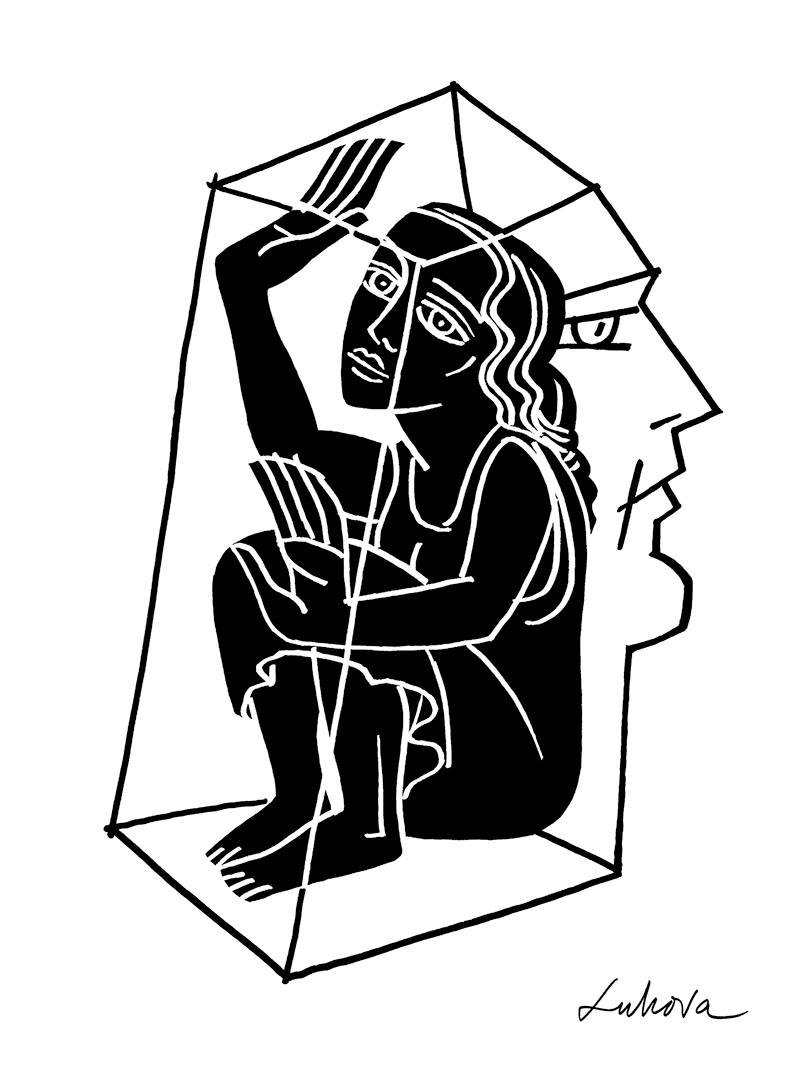
Junia, Serigraph, Remembering the Women: Works by Luba Lukova. Art © Luba Lukova
Unfortunately, there were technical difficulties so a recording of this worship service is unavailable.
Romans 16:1-7 (NRSVUE)
I commend to you our sister Phoebe, a deacon of the church at Cenchreae, so that you may welcome her in the Lord, as is fitting for the saints, and help her in whatever she may require from you, for she has been a benefactor of many and of myself as well.
Greet Prisca and Aquila, my coworkers in Christ Jesus, who risked their necks for my life, to whom not only I give thanks but also all the churches of the gentiles. Greet also the church in their house. Greet my beloved Epaenetus, who was the first convert in Asia for Christ. Greet Mary, who has worked very hard for you. Greet Andronicus and Junia, my fellow Israelites who were in prison with me; they are prominent among the apostles, and they were in Christ before I was.
Sermon Transcript
This morning I am back in the pulpit, so we are back to our series about women leaders in the Gospels and in the early church. So far we have explored the contributions of Mary Magdalene, Joanna, and Susanna, who were disciples of Jesus and financial supporters of his ministry.
And in the early church so far we have learned about several women who were co-workers with Paul and/or house church leaders in the earliest days of the church: Lydia, Priscilla, Chloe, Mary the mother of John Mark, Apphia, Nympha, Euodia, and Syntyche, among others.
This week we will add two more names to the list—and these two are notable because over the centuries that the Bible has existed, they, or at least their roles, have been lost in translation.
But before we get to their stories, I need to make sure we all understand about how the Bible we have now came to be, because understanding that is essential to understanding these women’s stories, and how it could be that for hundreds of years, they were essentially erased from our Bible.
What we now know of as The Bible—a bound book in two parts, each of which is comprised of many different books, each with their own author, or sometimes multiple authors within the same book—it was written mostly in Hebrew and Greek, with a bit of Aramaic sprinkled in.
So the Bible has many, many voices and perspectives, recorded over many, many centuries into the one volume we have today. But who decided which books got to be in the Bible and what order they should go in?
For the Hebrew Bible, it was Jewish rabbis and scholars who decided what would be included in the Law, the Prophets, and the Writings. They had figured this out pretty authoritatively a couple hundred years before Jesus was born.
And then for the New Testament, there was a whole process about 300 years after Jesus with a bunch of councils and debates and committee meetings. And then finally they came to a consensus of which books to include in the New Testament.
Once it was decided which books would be included the Bible, then there were lots of people whose job it was to make copies of the scriptures, and to translate the scriptures into other languages. They didn’t have printing presses, and they certainly didn’t have Google Translate, so it was up to human hands and minds to physically copy the words onto paper, and to decide which words to use in another language when translating the scriptures.
And since they were human, mistakes were made. Sometimes copying errors happened, where lines were omitted, or words were transposed. And sometimes translation errors were made, where maybe the word chosen in another language changed the meaning of the text away from what it had originally meant. Sometimes it is impossible to find an exact word for word translation when going from one language to another, and we are forced to paraphrase. And sometimes people choose the wrong word because of their own biases.
And then—over time, old copies of manuscripts got lost or destroyed or just turned to dust and became unreadable. So all we are left with are newer copies (that might have mistakes in them) and translations of the original (which may have translation errors in them).
Have you ever been reading your Bible and noticed a little footnote at the bottom of a page that said something like, “some manuscripts add [some extra words]” or “other ancient authorities read [something different].” Well, this is why—because we don’t have the original versions of any part of the Bible. We have copies and we have translations and copies of translations—and, because humans copied and translated these versions, none of them match one another exactly.
You can see this even when looking at modern versions of the Bible in English—read a passage in the King James Version and it is pretty different from the version we usually read from in worship (which is the New Revised Standard Version, in case you were wondering). So even modern translations in English can end up with entirely different words on their pages, for all sorts of reasons.
Ok, so now that I’ve gone on that massive tangent, let’s get back to the women who I want to talk about this morning, and hopefully that whole explanation I just gave will be helpful.
In the passage read for us today from Paul’s letter to Romans, in the first 2 verses of chapter 16 Paul tells the Roman church to welcome Phoebe, who has traveled from a far away church. He writes:
“I commend to you our sister Phoebe, a deacon of the church at Cenchreae (SEN-cree-ā), so that you may welcome her in the Lord, as is fitting for the saints…”
The word “deacon” is here is from the Greek word “diakonos”—so it is really less of a translation and more of a transliteration, that is, it doesn’t so much define the word as it just changes the letters around a little bit to make it sound like an English word. So “diakonos” gets changed to “deacon.”
But what does the word “deacon” actually mean? Well, we have deacons in our church, right? What do they do? They help, they serve, they lead, they organize. They do a lot of things, and we are so grateful to them for all the work they do on the church’s behalf! You could sum up what they do as ministering to the church, and in the New Testament, translators often use the word “minister” when they want to translate the Greek word “diakonos.”
Elsewhere in the Greek New Testament, Paul refers to himself as a “diakonos”, which often gets translated as “minister.” Same goes for the place where Paul calls his co-worker Timothy a “diakonos”—most translations say Timothy is a “minister.”
But guess what? When Paul calls Phoebe a “diakonos,” many translators who used the word “minister” for Paul or Timothy, now choose the word “servant” for Phoebe.
Why choose a different word? Well, Paul and Timothy are men, and Phoebe is a woman, so some translators let their own bias about who is and who is not qualified to be a deacon or minister creep in. So, in many translations over the centuries, Phoebe is allowed to be a “servant” of the church, but not a “minister,” simply because she is a woman and not a man.
And the translation bias against Phoebe doesn’t stop there! In the next verse, after Paul says the church in Rome should welcome Phoebe, he writes that they should:
“help her in whatever she may require from you, for she has been a benefactor of many and of myself as well.”
Now we are going to focus on the word translated here as “benefactor.” Our version uses “benefactor,” but other translators chose “patroness” (not patron, but patroness, because we need reminding that she is a *woman*), and still other translators chose the word “helper.”
Ok. But here’s the thing: in other places in the New Testament where a form of this word gets used to refer to men, it gets translated as “leader” or “ruler” or “manager.”
So for a woman, we get “benefactor” or “helper,” but for men we get “leader” or “ruler.” Hmm.
It is clear that Phoebe was a wealthy woman who used her wealth to support her church and to support Paul. Under the Roman system of patronage, using one’s wealth to support others would confer a certain amount of power. But here it seems that, while Phoebe gets credit for sharing her wealth as a benefactor, she does not get acknowledged as the leader she likely was in the church.
And if the way Phoebe gets treated by translators isn’t bad enough, wait until you hear about Junia! A bit further down in this 16th chapter of Romans, Paul send greetings to:
“Andronicus (An-DRAH-nǐ-cus) and Junia, my fellow Israelites who were in prison with me; they are prominent among the apostles, and they were in Christ before I was.”
In just about every English language Bible, there is a little note after Junia’s name that says something like:
“Or Junias; other ancient authorities read Julia.”
So which is it? Junia, or Junias, or Julia? How can there be so many options?!?
Well, if Phoebe fell victim to translator bias and error in erasing her position in the church, Junia is a victim of transcription. Remember how I said that it was someone’s job just to copy out the text of the scriptures by hand?
Well, somewhere after those first few centuries, some scribe or scholar somewhere was reading as he was copying, and he saw that Junia had been imprisoned with Paul, and that Paul described this person as “prominent among the apostles,” and the scribe thought, “Nahhhh, this must be a mistake! Paul couldn’t possibly have meant a *woman* was an apostle! It must be that the “S” got left off somewhere. Here, I’ll fix it.” And so, for centuries, Junia became Junias.
But all of the oldest manuscripts we have say either Julia or Junia (which were both common names for Roman women), not Junias (which was the name of no Roman man at the time).
So there was no mistake. It was Junia (or possibly Julia, but let’s stick with Junia just to be slightly less confusing) whom Paul praises so highly, calling her and her colleague (probably her husband or a close relative) “prominent among the apostles.”
Fortunately, most modern Biblical scholars and translators are in the habit of going back to the oldest manuscripts that we have available, and since those manuscripts clearly use a woman’s name, Junia has been restored to the pages of our Bibles at last.
However, there are some today who still try to erase Junia by saying that we should translate this verse as saying that she and Andronicus were well known TO the apostles, but not actually AMONG the apostles. Because there are definitely still folks today who cannot abide the notion that yes, the role of apostle was open to women as well as men. They also have to conveniently forget that Jesus himself sent Mary Magdalene as an apostle to the apostles on that very first Easter morning. But they have no problem with dismissing that, either.
———
I also want to say this morning that it is not just women who have been the victims of bias from translators of the Bible. The year before we moved from Waco, my family had a chance to attend a screening of the documentary 1946: The Mistranslation That Shifted Culture, which is all about how the word “homosexual” appeared in a translation of the Bible for the very first time in 1946. The film asserts that this was a mistranslation and caused irreparable harm to the LGBTQ+ community. I recommend the film, it is available to watch online.
The problem here is that the Greek words that they chose to translate as “homosexual” in 1946, are really weird Greek words, and no one reallly knows what they mean. We think they have *something* to do with men having sex with men (or possibly boys?), but there is a really good chance that the sex was abusive and/or exploitative in some way. It certainly didn’t refer to sex between consenting adults of the same gender, since that whole concept (at least in a legal sense) didn’t really exist until about 50 years ago. Choosing a word that could refer to a loving, consenting relationship to include in a list of actions that are clearly sinful has certainly caused harm to LGBTQ+ folks.
———
So, the words translators choose matter. The words translators use are powerful, especially when we are talking about the Bible, which we use to help shape our understanding of how the world should be, and how we should relate to one another and to God. When translators and scholars make mistakes—it matters.
Are there ways that people with power over these words have tried to shape the message to their own ends, tried to bury the truth that the love of God expressed in Jesus is one of inclusion? Yes.
But—there are also people who don’t give up on that idea. Who continue to wrestle with the biblical text, instead of abandoning it altogether. Who make discoveries and who petition for corrections to be made. And there is hope in that. There is hope that Christ’s message of inclusive love cannot be always obscured.
Because what made Jesus so extraordinary, was that he could cut through all the noise and all the cultural barriers that society erects between us, and he touched people. He connected with them. He saw the inherent value in people, no matter what the prevailing attitude of society was toward them.
And we know about that because we read it in our Bible. But how can something so messy truly help us to see and know God? The Bible is God-inspired, but it has human fingerprints all over it. And not clean fingerprints—messy, sticky ones, like a toddler who has been eating chocolate and got hold of a favorite book.
And yet. In spite of (or maybe because of? I can’t tell which.) the mess we have made of this holy book, we can still find God when we look. Because thank the Lord, God is still speaking, and not just through the words we find in these pages, but also through the Spirit-filled connections we make with one another and with this amazing world God made. And there is definitely hope in that.
Thanks be to God!